
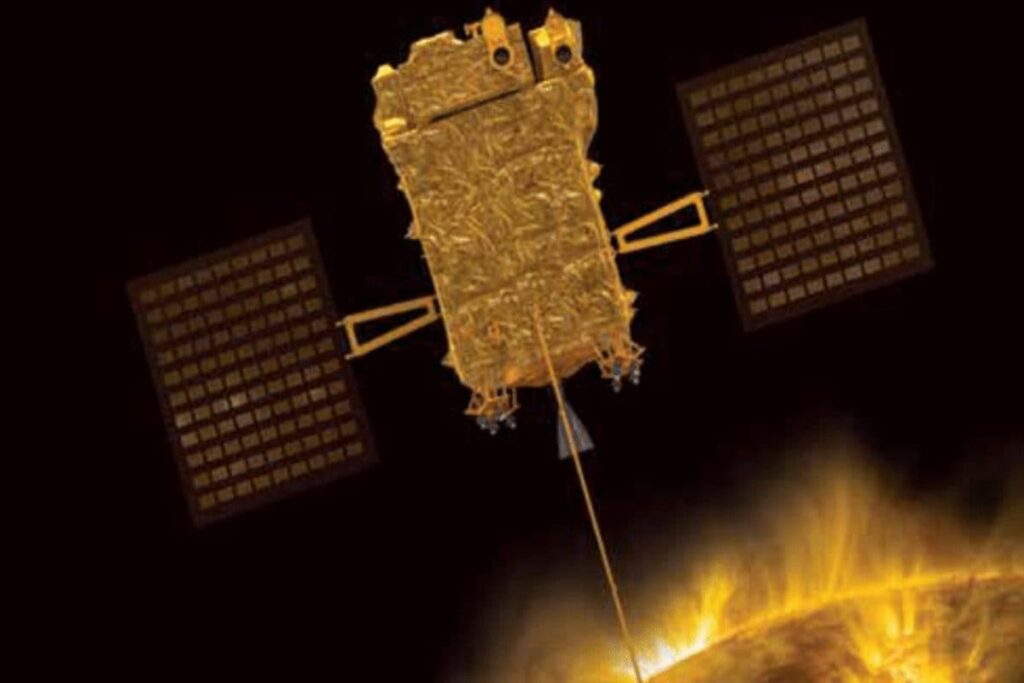
The Indian Space Research Organisation’s (ISRO) maiden solar mission, Aditya-L1 achieved another milestone as its Solar Wind Particle Experiment (ASPEX) payload onboard the satellite began its operations, performing normally. The ASPEX has two instruments, Solar Wind Ion Spectometer (SWIS) and SupraThermal and Energetic Particle Spectrometer (Steps). The Steps instrument started being operational on September 10, while the SWIS instrument was activated on November 2, an India Today report said.
Both the instruments have thus far projected optimal performance. WHAT IS SWIS? The SWIS instrument utilises two sensor units, each with a 360-degree field of view. It operates in the planes which are at right angles (90 degree) or perpendicular to each other.
ISRO has said that the instrument has analysed the solar wind ions, energy variations in proton and alpha particles. Reportedly, a sample energy histogram which was acquired from one of the two sensors over a couple of days in November 2023, depicts variations in the counts of proton — H+ — and alpha particle — double ionised helium, He2+. These variations were recorded with the time — nominal integration time — during which voltage signal is held as it maximises and stabilizes, enabling sensors to measure it.
This provides an all-inclusive snapshot of the solar wind behavior patterns. SWIS has such directional potential which helps in precisely measuring the solar wind protons and alphas. This notably contributes to answering the long-time pending questions about solar wind properties, fundamental processes and their effect on the Earth.
The change in the number ratio of proton and alpha particle, as observed by SWIS, has the capability of provide incidental information about the coming of Coronal Mass Ejections (CMEs) at the designated point of the mission, which is the Sun-Earth Lagrange Point (L1), ISRO said. An amplified alpha-to-portion ratio is often said to be one of the sensitive indicators of the passage of interplanetary coronal mass ejections (ICMEs) at the Lagrange Point L1. Thus, making it crucial for space weather studies.
Last week, ISRO chief S Somanath said that the Aditya L-1 spacecraft is expected to complete its maneuvers and reach the L-1 point by January 7, 2024. “Aditya is doing well and is almost done with its final phase,” Somanath was quoted as saying by PTI. Recently, the national space agency had shared that Aditya L1’s High Energy L1 Orbiting X-ray Spectrometer (HEL1OS) instrument detected a sudden energy burst from a solar flare.
The spacecraft was launched from Sriharikota’s Satish Dhawan Space Centre on September 2. India’s first solar mission carries a total seven different payloads to study the Sun. Four of these payloads will observe the light from the Sun and the remaining three will measure in-situ parameters of the plasma and magnetic fields.
The spacecraft will be placed in halo orbit around the L1 point, which is at a distance of 1. 5 million km from the Earth in the direction of the Sun. ( With PTI inputs).
From: news18
URL: https://www.news18.com/india/aditya-l1-sun-isro-another-milestone-key-solar-instrument-operation-solar-wind-particle-experiment-swis-8686962.html