
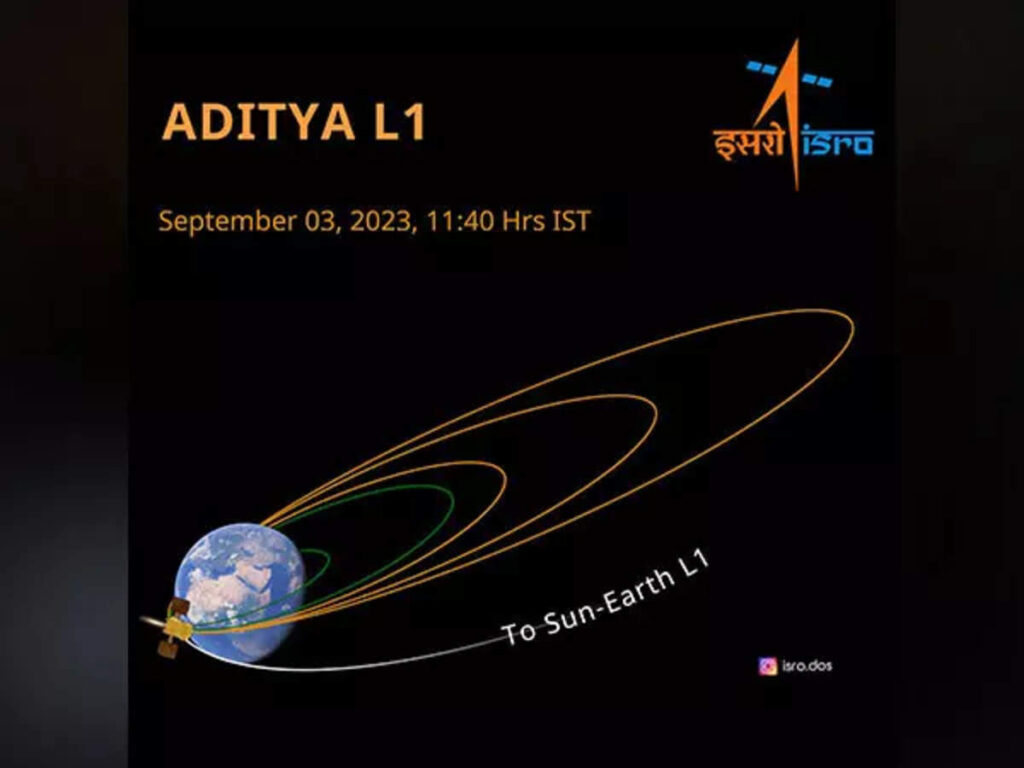
Synopsis The Aditya L1 mission, the first Indian space-based observatory to study the Sun, has successfully undergone its second earth-bound manoeuvre. The operation was carried out by ISRO’s Telemetry, Tracking and Command Network. The spacecraft will undergo two more earth-bound manoeuvres before being placed in the transfer orbit towards the Lagrange point L1.
Aditya L1 is expected to arrive at its intended orbit after approximately 127 days. The mission aims to continuously observe the Sun without any occultation or eclipses, providing real-time information about solar activities and their impact on space weather. ANI Aditya-L1 sun mission: First earth-bound manoeuvre successful, satellite healthy Aditya L1, India’s pioneering space mission dedicated to studying the Sun , has successfully completed its second earth-bound manoeuvre.
The Indian Space Research Organisation ( ISRO ) made this announcement during the early hours of Tuesday, marking a crucial step in the mission’s progress. The manoeuvre, known as the “second Earth-bound manoeuvre (EBN#2),” was executed flawlessly by ISRO’s Telemetry, Tracking, and Command Network (ISTRAC) located in Bengaluru. The operation was closely monitored by ISRO’s ground stations in Mauritius, Bengaluru, and Port Blair.
The result of this manoeuvre is a new orbit with dimensions measuring 282 kilometers by 40,225 kilometers. Looking ahead, the third manoeuvre (EBN#3) is scheduled for September 10, 2023, at around 02:30 Hrs. IST.
Aditya-L1 distinguishes itself as the first Indian space-based observatory designed to study the Sun. It orbits the first sun-earth Lagrangian point (L1), situated approximately 1. 5 million kilometers away from Earth .
The mission’s initial earth-bound manoeuvre was successfully executed on September 3, setting the stage for what lies ahead. The spacecraft is anticipated to undergo two more earth-bound orbital manoeuvres before it is transferred to its final destination, the Lagrange point L1. Aditya-L1 is projected to reach its designated orbit at the L1 point after approximately 127 days.
The Aditya-L1 spacecraft was launched into space aboard ISRO’s Polar Satellite Launch Vehicle (PSLV-C57) on September 2, 2023, from the Second Launch Pad of Satish Dhawan Space Centre (SDSC) in Sriharikota . Following a 63-minute and 20-second flight, Aditya-L1 successfully entered an elliptical orbit measuring 235 kilometers by 19,500 kilometers around Earth. This unique orbit allows the satellite to continuously observe the Sun without interruptions caused by occultation or eclipses.
This clear picture will provide important insights into solar activity and its impact on real-time space weather. ISRO and national research laboratories, including the Indian Institute of Astrophysics (IIA) in Bengaluru and the Inter University Centre for Astronomy and Astrophysics (IUCAA) in Pune, designed seven scientific payloads for Aditya-L1. Using electromagnetic, particle, and magnetic field detectors, these payloads are designed to investigate various parts of the Sun, including the photosphere, chromosphere, and the outermost layers known as the corona.
Four of these payloads will be able to directly see the Sun, while the remaining three will study particles and fields at the Lagrange point L1. These observations will provide essential scientific data on coronal heating, coronal mass ejections, pre-flare and flare activity, space weather dynamics, and particle and field propagation. Scientists feel that knowing these events is critical to understanding the Sun’s intricate workings and interactions with our solar system.
To put this in context, there are five Lagrangian points between Earth and the Sun where small objects can maintain stable positions while using little fuel. These points are named after the Italian-French mathematician Joseph-Louis Lagrange, who introduced them in his renowned 1772 paper, “Essai sur le Probleme des Trois Corps. ” These Lagrange points offer an advantage to spacecraft, allowing them to conserve fuel while remaining in a stable position where the gravitational pull of the Sun and Earth is balanced by the necessary centripetal force.
Aditya L1’s mission is poised to make the most of this unique vantage point, offering unprecedented insights into the Sun and its activities. (With inputs from PTI) Don’t miss out on ET Prime stories! Get your daily dose of business updates on WhatsApp. click here! Print Edition Tuesday, 05 Sep, 2023 Experience Your Economic Times Newspaper, The Digital Way! Read Complete Print Edition » Front Page Pure Politics Companies ET Markets Learn more about our print edition More Bain Dials DRL to Team Up for Joint Cipla Bid US buyout group Bain Capital has approached Dr Reddy’s Laboratories (DRL) to explore a joint bid to buy out the promoters of Cipla, the Hamied family.
3, 2, 1… Mission on to Spot Stars of Startup Galaxy A star-studded jury led by Kotak Mahindra Bank founder and director Uday Kotak will meet virtually on September 12 to pick the winners of The Economic Times Startup Awards 2023, marking the launch of the ninth edition of India’s most coveted recognition for entrepreneurial excellence. Read More News on earth isro sun lagrange sriharikota (Catch all the Business News , Breaking News Events and Latest News Updates on The Economic Times . ) Download The Economic Times News App to get Daily Market Updates & Live Business News.
. . .
more less ETPrime stories of the day Interviews Same-day delivery is our lowest carbon option, says Amazon’s sustainability head Kara Hurst 10 mins read Economy Uniting a divided world: why India faces a tough balancing act at the G20 Summit 8 mins read Markets SN Subrahmanyan understands L&T’s values, will carry on entrepreneurial actions: AM Naik 4 mins read Subscribe to ETPrime.
From: economictimes_indiatimes
URL: https://economictimes.indiatimes.com/news/science/aditya-l1-successfully-undergoes-the-second-earth-bound-manoeuvre-isro/articleshow/103372258.cms