
If you buy something from a Verge link, Vox Media may earn a commission. Anker was , in August 2023, and while in the world seems to be now, Anker’s are the first I’ve gotten my hands on. For iPhone users, Qi2 is an easy sell already: with a compatible iPhone, it’s less expensive than certified MagSafe chargers and just as fast.
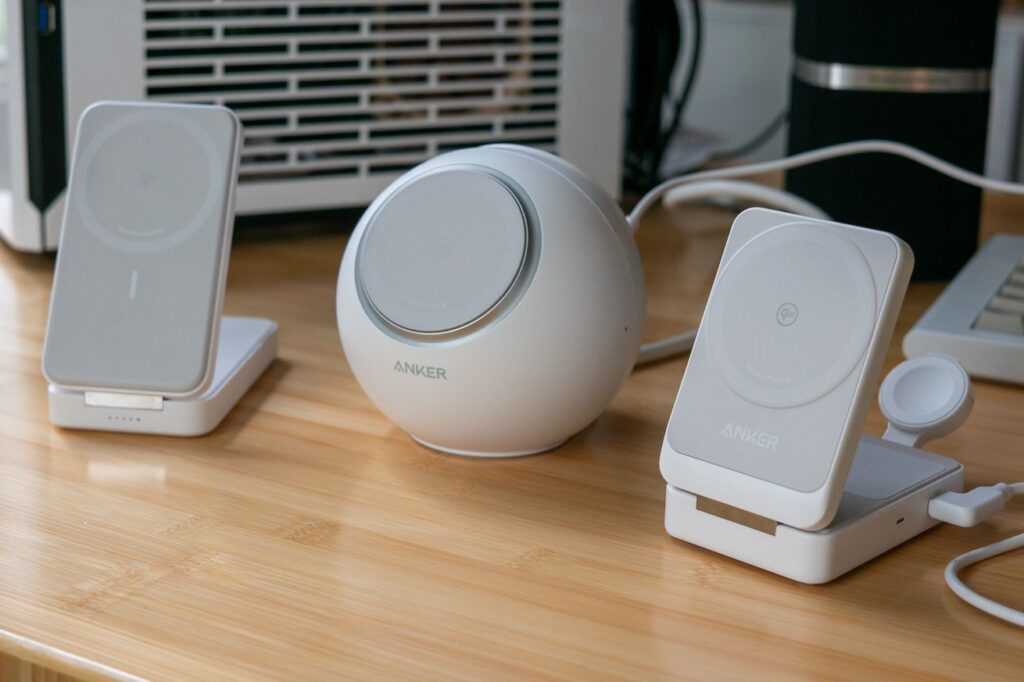
It’s less compelling so far for Android users or mixed-platform households, though — it’s slower than regular Qi charging on non-certified devices. I have spent a couple weeks with three Anker Qi2 devices, all of which are available today: the $109. 99 MagGo Wireless Charging Station (Foldable 3-in-1), the $69.
99 MagGo Power Bank (6,600mAh capacity), and the $99. 99 MagGo Magnetic Charging Station (8-in-1), popularly known as the Orb. All three charge at the rate they’re supposed to, hold the iPhone at least as firmly as real MagSafe, and look pretty good.
And they’re less expensive than MagSafe-certified chargers; the orb and power bank don’t have direct competition, but the three-in-one charger is about $40 less than the going rate for MagSafe-certified three-in-ones. Qi2 (properly Qi v2. 0 MPP, for Magnetic Power Profile) is a new that can charge compatible devices at up to 15W.
Like Apple’s MagSafe, it uses rings of magnets in both device and charger to ensure proper alignment of the charging coils, and it’s based on the Qi wireless charging standard that’s used by nearly every device that offers wireless charging. In fact, to the new standard. Unlike MagSafe, Qi2 isn’t proprietary.
It’s administered by the Wireless Power Consortium, and although devices need to be Qi2-certified, they don’t require special Apple hardware or MFi certification, which means they’re less expensive to produce. As of iOS 17. 2, the iPhone 13, 14, and 15 are Qi2-certified and can charge just as fast from a Qi2 charger as they can from a MagSafe-certified charger; on all other wireless chargers, iPhones are limited to 7.
5W maximum. Because Qi2 is an open standard, it can be integrated into Android phones and other devices. Most Android phones top out at around 10W with standard Qi chargers, though some (like Samsung Galaxy phones and Google Pixels) can charge faster with proprietary wireless charging stands.
In the near future, households with Android and iPhones should be able to share the same magnetic chargers and accessories and get the same charge rates. The MagGo Power Bank is a lot bulkier than its 6,600mAh capacity would indicate. It’s more of a portable charging stand than the type of thing you’d slap on the back of your phone when you’re on the go.
At 266g, it’s 55g heavier than my iPhone 14 Pro and over 100g heavier than the 5,000mAh I own. But its hinge is a lot sturdier than the floppy kickstand on the 622 battery, it recharges your phone twice as fast, and it supports passthrough charging. If you plug it into the wall when the battery’s full, it charges the phone at full speed; if the battery’s empty, it charges both at about the same rate.
I do not know why Anker made its Qi2 folding three-in-one charging station look just like its Qi2 folding power bank. I keep mixing them up. Regardless, this thing is neat.
The Apple Watch puck flips out from the base, so it’s not always hanging out if you don’t have an Apple Watch, and the Qi2 stand angle can keep its position anywhere from about 15 to 85 degrees. Opening the stand reveals the 5W Qi charger inside, which is perfect for charging AirPods or other wireless earbuds. It’s thick, like the power bank, but at least its shape makes it a little easier to take on the go than the MagSafe-certified .
The three-in-one comes with a 40W AC adapter; according to the specs, it can output up to 15W via Qi2 and 5W each from the Apple Watch and Qi chargers. The Anker MagGo Magnetic Charging Station 8-in-1, aka the Orb, is $99. 99 — about $30 more than the .
It has two USB-A ports and two USB-C ports and can support up to 67W total power output, including up to 15W from the Qi2 charger (it can support a lot more through its three AC outlets). You can get a real desk octopus going here, or replace an entire power strip’s worth of chargers. Ponder that, if you will.
Anker is also announcing: From my limited testing, all three Qi2 chargers seem to charge my iPhone 14 Pro at up to 15W, just like an Apple MagSafe charger. Apple and charger manufacturers always say “up to 15W” because the iPhone won’t always use all that power. It’ll hit 15W for a bit if the battery is particularly low, then drop the rate as it fills up or if the phone gets too hot.
In my experience, that mostly meant charge rates of about 12 or 13W. The . My spouse’s iPhone 14 Pro, which was still on iOS 17.
1, topped out at 7. 5W — the maximum rate for Qi v1 wireless charging, magnetic or otherwise — until I updated the software. I also tested the folding three-in-one charger with a Samsung Galaxy S22.
The S22 can charge at up to 10W with a standard Qi charger — or a MagSafe-compatible charger like the — but maxed out at 5W with Qi2. So if you’re someone, like my editor Dan Seifert, who slaps magnetic rings on the backs of Android phones so you can use magnetic Qi accessories, you don’t need to rush to upgrade to Qi2 just yet. “an enhancement to the existing wireless charging Extended Power Profile (EPP) that does not include magnets but complies with the Qi v 2.
0 standard,” and Qi v2. 0 devices will all be interoperable, so it’s conceivable that older devices without magnets could get Qi v2. 0 compatibility via software update.
has reached out to the Wireless Power Consortium to ask if that’s possible. The appeal of Qi2 for iPhone users is that it gives you real MagSafe charge rates for less money, and there are already Qi2 chargers announced than there ever were official MagSafe-certified chargers. The going rate for a MagSafe-certified three-in-one charger is about $150, excluding sales.
Anker’s Qi2 three-in-ones range from $90 to $110. The basic Qi2 charging pad is $21 with an AC adapter; Apple’s MagSafe charger is $40 without, and Belkin’s MagSafe pad is $30 without an AC adapter and $40 with. The only thing I can think of that official MagSafe does and Qi2 doesn’t is remember which Standby display you want on which charger.
But we’re already seeing sales on some MagSafe-certified chargers to bring the prices closer to Qi2, so maybe this tide will lift even that boat. /.
From: theverge
URL: https://www.theverge.com/24027019/anker-qi2-hands-on-magsafe-speed