
Hollywood & Entertainment ‘Coin: A Founder’s Story’ Offers A Meticulous Look At Crypto And The Ups And Downs Involved In The Origins Of Brian Armstrong’s Coinbase Josh Wilson Contributor Opinions expressed by Forbes Contributors are their own. I cover film, TV, and entertainment through the lens of a producer. Following New! Follow this author to stay notified about their latest stories.
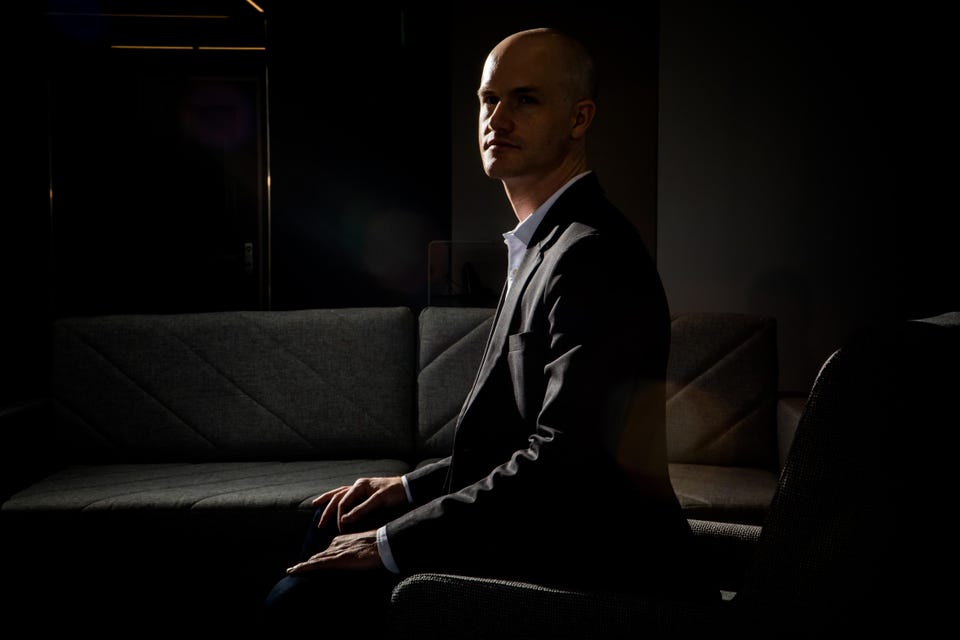
Got it! Oct 10, 2022, 01:24pm EDT | New! Click on the conversation bubble to join the conversation Got it! Share to Facebook Share to Twitter Share to Linkedin San Francisco, CA – May 4, 2018: Coinbase CEO Brian Armstrong sits for a portrait in their San . . .
[+] Francisco headquarters. (Photo by Christie Hemm Klok for The Washington Post via Getty Images) The Washington Post via Getty Images Like every origin story – hero or villain – Coin: A Founder’s Story from 10-time Emmy-award-winning director Greg Kohs starts off looking at Brian Armstrong’s childhood, his fascination with computers, and also the World Wide Web. A documentary about Coinbase’s journey to an IPO, the story covers the breadth of Coinbase’s history, finishing with its IPO on the Nasdaq on April 14th 2021.
Though very detailed and insightful, what remains interesting at the culmination of the piece are the questions left unanswered. Before looking at the piece itself, it’s important to dig into who authored and had editorial control of the film. In film and TV it is seen as important —and oftentimes editorially necessary—for the individual who has editorial control, and ultimately Final Cut (who signs off on the finished film) to not be the same person as the subject of the piece.
It’s still ambiguous as to where this film stands. Editorial control Alldayeveryday, a bi-coastal full-service production company based in New York and Los Angeles made the film. The company has created branded entertainment for Nike NKE , Vans, Lyft LYFT , Facebook and Beats to name a few and has produced films with Michael Pitt for Rag & Bone and Greta Gerwig for DKNY.
With this history, it’s possible that Coinbase could have paid for the film to be made which automatically, and unfortunately, could change the scope of the title and the impartiality around its point of view. On the other hand, based on how Armstrong’s character comes off in the piece you would hope that Kohs was given editorial control and Final Cut (especially with his stature) meaning Armstrong would not have a say on what the finished film looks like. The problem becomes if Coinbase did fund the project, just how much control did they have over the editorial? NEW YORK, NY – APRIL 21: Director Greg Kohs attends the “AlphaGo” premiere during 2017 Tribeca Film .
. . [+] Festival at Spring Studios on April 21, 2017 in New York City.
(Photo by Noam Galai/Getty Images for Tribeca Film Festival) getty MORE FOR YOU They Inherited Billions Upon Billions: Meet America’s Richest Heirs Here’s Microsoft’s Streaming Micro Xbox, ‘Leaked’ By Phil Spencer Atlanta Braves Give Rookie Pitcher Spencer Strider Record Extension That’s not to say that the film simply looks at Coinbase with rose-colored spectacles on all the time. It does not. There are controversies involving the Neutrino acquisition and Armstrong’s all-business approach to Black Lives Matter (BLM) that particularly stand out.
Overall, however, the film is a positive take on crypto as an industry and its potential, whilst deciphering the personality of Brian Armstrong. The documentary largely focuses on Armstrong’s personal and business relationships, especially with co-founder Fred Ehrsam. In contrast to Mark Zuckerberg’s notorious co-founder story, Ehrsam and Armstrong aimed to amicably solve their differences, and when they could not Ehrsam left to find his own path whilst remaining on Coinbase’s board.
There’s even an anecdote that Armstrong gifted Ehrsam more shares in Coinbase after leaving, something an investor in the company commented on as something that “never happens”. Decentralization and the State The matter of regulation is referred to consistently as an area Coinbase wants to openly be receptive to and even enhance conversations on. Katie Haun, a former Department of Justice federal prosecutor who created the U.
S. government’s first cryptocurrency task force and was asked to investigate Bitcoin BTC , makes an appearance in the piece. Haun represents Coinbase as a member of its board of directors, yet her insight in regards to investigating crypto and realizing that it was technology rather than simply an illicit means of furthering criminality was an important inclusion.
Haun also comments on using blockchain to track criminality as she mentions she “used crypto to chase criminal involvement ” whilst the film itself talks about how crypto actually makes it much easier to track illegal transactions compared to fiat through John Kothanek, the senior director of the Global Intel Group at Coinbase. Hester Pierce, the commissioner for the Securities And Exchange Commission (SEC) also makes an appearance, remaining bullish on new technologies and what can potentially be possible with crypto. WASHINGTON, DC – JUNE 07: Deputy U.
S. Attorney General Lisa Monaco speaks at a press conference with . .
. [+] FBI Deputy Director Paul Abbate and Acting U. S.
Attorney for the Northern District of California Stephanie Hinds on June 7, 2021 at the Justice Department in Washington, D. C. The DOJ announced the recovery of millions of dollars worth of cryptocurrency from the Colonial Pipeline Co.
ransomware attacks. (Photo by Jonathan Ernst-Pool/Getty Images) Getty Images The concept of crypto as a “revolutionary human rights tool” also comes up with anecdotes on case studies surrounding Nigeria and Belarus, and how the inherent financial system gives the state overwhelming control to oppress freedoms. Kenneth Rogoff, a professor of Economics at Harvard University comments on the subject.
“The balance between freedom and self-control, Bitcoin makes me think about that,” he says in the film. The film communicates that the 2008 financial crash as well as state financial oppression were, and are, heavily caused by human process, greed, and error. The decentralization of finance could be a fix to this, but simultaneously there must be recognition that governments will always have the final say.
Regulation should be pushed for rather than resisted. A segment looks at Armstrong in D. C meeting various Senators that could potentially aid in regulation , but that it is no small task.
WASHINGTON, DC – APRIL 26: Sen. Elizabeth Warren (D-MA) questions Consumer Financial Protection . .
. [+] Bureau Director Rohit Chopra as he testifies before the Senate Banking, Housing and Urban Affairs Committee April 26, 2022 in Washington, DC. Chopra testified on the Consumer Financial Protection Bureau’s Semi-Annual Report to Congress and other topics during the hearing.
(Photo by Win McNamee/Getty Images) Getty Images The Neutrino acquisition gave the audience a look into Armstrong’s thought process as a leader, as he comes across as level-headed and someone that owns up to his mistakes and more importantly, wants to learn from them. Coinbase acquired Neutrino, an algorithmic stablecoin pegged to the dollar but backed by another algorithmic protocol, in March of 2019. Shortly after the acquisition, users were quick to point out that Neutrino was run by an infamous team of hackers who sold spyware regimes in Saudi Arabia, Sudan and Venezuela.
Black Lives Matter The juxtaposition of Armstrong’s stance on BLM was interesting to watch. On one hand, he constantly talks about his goal to democratize finance and create fairness throughout the world, whilst simultaneously saying that Coinbase, as a company, would not stand for political movements like BLM. A movement that was predicated on the historic unfair treatment of those of African descent, specifically around finance and monetary systems.
In this instance, in the United States. One would have assumed—based on the history involving redlining and monetary enforcement practices to denigrate, devalue, and unravel black communities—that Armstrong would have positively aligned the company with the movement . The goals seem similar across vertices.
Instead, he opted for a heavy-handed approach with an unemotional public statement amidst walkouts amongst some of his employees. A strange paradigm for a man that has signed the giving pledge, and one that did not quite make sense to me. Even when talking about BLM his stance seemed a tad wishy-washy, saying he agreed with some of BLM’s thoughts and goals.
It struck me that there was a staunch disconnect with Armstrong between BLM as an organization and anti-racism, equity, and equality as values. If it was an issue around child trafficking or something less divisive in American society I question whether Armstrong’s stance would have been the same. People hold up placards in support of the Black Lives Matter movement as they take part in the .
. . [+] inaugural Million People March march from Notting Hill to Hyde Park in London on August 30, 2020, to put pressure on the UK Government into changing the “UK’s institutional and systemic racism”.
– The march is organised by The Million People Movement, and takes place on the bank holiday weekend usually associated with the Notting Hill Carnival, this year cancelled due to the coronavirus covid-19 pandemic. (Photo by JUSTIN TALLIS / AFP) (Photo by JUSTIN TALLIS/AFP via Getty Images) AFP via Getty Images Conclusion The film concludes with Coinbase’s historic IPO in 2021 as Armstrong seemingly remains calm throughout, as does co-founder Ehrsam, as the piece caps off focusing on their friendship and how as co-founders they’re still friends. The film is worth watching and gives a robust look at Crypto as a whole.
Its educational value is certainly there. Though the piece shows interviews with ex-employees, post the BLM scandal in particular, the film doesn’t show any extraordinary controversies and is largely very positive on everything, not even looking at – or mentioning – any other exchanges outside of Coinbase . There’s not much of an offering on counterpoints or negative perspectives either, outside of U.
S. Senator Elizabeth Warren being reticent on if crypto is an overall answer to the world’s financial woes. This seems strange given the hit crypto has taken in 2022 , but the film culminates in Q2 of 2021 afterall.
Armstrong ultimately comes across as a mild-mannered, pragmatic , heavy introvert who cares about people, his company, and the history of finance, whilst wanting to improve his function as a CEO. Follow me on Twitter or LinkedIn . Josh Wilson Editorial Standards Print Reprints & Permissions.
From: forbes
URL: https://www.forbes.com/sites/joshwilson/2022/10/10/coin-a-founders-story-offers-a-meticulous-look-at-crypto-and-the-ups-and-downs-involved-in-the-origins-of-brian-armstrongs-coinbase/