
Dr. Mariell Jessup, chief science and medical officer of the American Heart Assn. , said she couldn’t say for sure what caused Buffalo Bills safety Damar Hamlin’s heart to stop during an NFL game Monday night.
But she was sure of one thing: “Everyone needs to know how to do CPR. ” Hamlin’s sudden collapse has been traumatic for his family, his team and athletes in general. But if it prompts more Americans to become adept at cardiopulmonary resuscitation, that would be quite a silver lining.
In Southern California, hundreds of courses are available in how to give CPR and how to reboot someone’s heart with an automated external defibrillator, or AED. Research shows that quick access to one or both forms of treatment dramatically increase the chances of surviving a cardiac arrest. The Centers for Disease Control and Prevention estimate that about 90% of the people who go into cardiac arrest outside a hospital die.
However, if CPR is performed within the first few minutes, it “can double or triple a person’s chance of survival,” the CDC says on its website. “You never know where you’re going to have the chance to save a life,” Jessup said in an interview with MedPage Today . “So if we learn anything during this tragedy, it is learn CPR.
” Sports Buffalo Bills safety Damar Hamlin suffered cardiac arrest on the field Monday night in Cincinnati. Here’s our coverage. When someone’s heart stops, so does the circulation of oxygen-rich blood to the far reaches of their body.
That’s particularly bad for the brain, which needs blood to perform its role as commander of the central nervous system, sending signals to muscles and nerves throughout the body. “Almost immediately after oxygen intake has ceased, brain cells begin to perish ,” UC Santa Barbara’s Science Line site says. It takes only three to six minutes of oxygen loss before the brain incurs damage, the site adds.
CPR mimics the pumping action of the heart, getting blood circulating again inside a person who’s in cardiac arrest. The American Heart Assn. outlines two approaches, one for medical professionals and other trained personnel, and one for ordinary bystanders: Starting CPR right away is essential; according to the heart association, every minute of delay decreases the odds of survival by 10%.
Nevertheless, the first thing you should do is ask someone to call 911 and look for a defibrillator (more on that in a bit). Science & Medicine After Damar Hamlin suffered a cardiac arrest on the football field, fans have asked whether COVID-19 vaccines could have played a role. Medical experts say the answer is almost certainly no.
The “hands only” approach to CPR is a simple but effective way to help teens or adults in cardiac arrest, the heart association says. To do it, put the heel of one hand in the middle of the person’s chest, put your other hand on top, then push down hard and let the chest spring back. You’ll need to do this rapidly, about 120 times per minute.
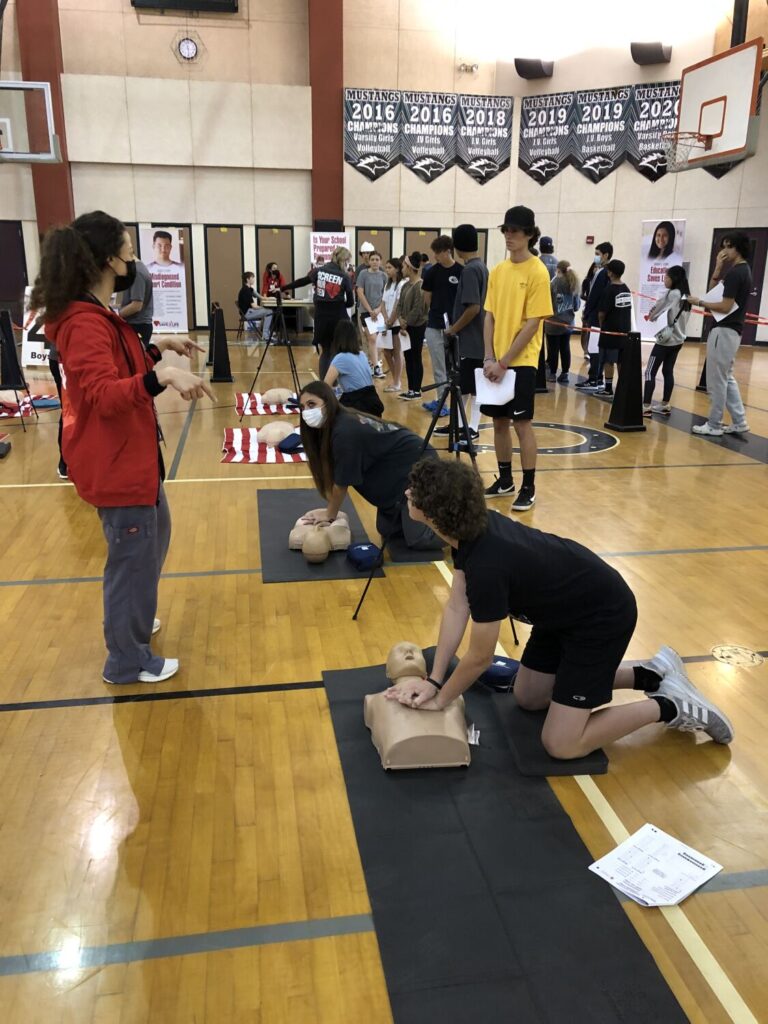
Don’t stop until EMTs arrive. If this seems daunting to you, or if you’d like to know how to adjust CPR for infants and children, get some training. Numerous organizations offer CPR classes, which typically can be completed in a couple of hours.
Two ways to find training are to search the American Red Cross’ lineup of classes or to consult the American Heart Assn. ’s roster of approved training centers . Costs range from less than $40 to more than $100, depending on how many lifesaving skills are being taught.
The lower-priced classes tend to offer instruction online only. If you want a certificate showing that you’ve met federal Occupational Health and Safety Administration standards, you’ll need at least some hands-on training. Such certificates are good for two years before they need to be renewed, according to the Red Cross.
Providing chest compressions can keep someone alive, but it can’t restart a heart that went into sudden cardiac arrest, medical experts say. For that, you’ll need an automated external defibrillator to deliver electric shocks that can restore heartbeat. According to the heart association, people who suffer cardiac arrest in a public place are more than twice as likely to survive if a bystander restarts their heart with an AED before first responders arrive.
That finding came from a Canadian study published in 2018, which found that 60% of the cardiac arrests experienced outside a hospital could be treated with an AED (though not all of them were). AEDs can analyze whether a person’s collapse was caused by a wildly irregular heart rhythm or complete cardiac arrest, then administer the right kind of shock. As with CPR, time is of the essence; the sooner the defibrillator does its thing, the greater the chance of recovery.
Sports Damar Hamlin collapses and receives CPR on field during game against Cincinnati Bengals. He is in critical condition. The Red Cross’ website suggests these steps for using an AED on an adult or a child at least 8 years old and weighing at least 55 pounds: Again, if this seems daunting, you can get trained on AED use as part of a CPR class.
You can find a class through the Red Cross, the American Heart Assn. or by searching online for “CPR and AED training near me. ” AEDs are mounted in many public places , including offices, schools, shopping malls, grocery stores and airports, the Food and Drug Administration advises.
Sadly, you cannot search for them on Google Maps. Not if you try to help in good faith. California law protects people who provide emergency and non-emergency help from being sued as long as the aid is provided for free and does not involve “an act or omission constituting gross negligence or willful or wanton misconduct.
” About The Times Utility Journalism Team This article is from The Times’ Utility Journalism Team. Our mission is to be essential to the lives of Southern Californians by publishing information that solves problems, answers questions and helps with decision making . We serve audiences in and around Los Angeles — including current Times subscribers and diverse communities that haven’t historically had their needs met by our coverage.
How can we be useful to you and your community? Email utility (at) latimes. com or one of our journalists: Matt Ballinger , Jon Healey , Ada Tseng , Jessica Roy and Karen Garcia . .
From: latimes
URL: https://www.latimes.com/california/story/2023-01-04/where-to-learn-cpr-damar-hamlin