
An e-bike battery boost feels like that first sip of coffee in the morning. No zoom, no push back into the seat you’d get from pressing on an accelerator pedal or throttle. Just a lightening of effort — an encouragement that this won’t be so hard after all.
We rented a pair of e-bikes in Missoula for a weekend birthday getaway. It made good financial sense: $80 a day vs. $140 if we’d contracted with a rental shop on the park’s fringe.
Although the tradeoffs come in other directions, too. The e-bikes weighed 60 pounds apiece — twice as much as our acoustic bikes and too heavy to carry with a strap-mounted bike rack. We drove through the St.
Mary entrance and around the long lake shore to Sun Point. A huge parking lot dwarfs a tiny picnic area, almost mocking the legacy of the Going-to-the-Sun Chalets complex that used to greet visitors. We chose this as our training ground, in case the newfangled transports threatened to buck us off or bolt for the trees.
The handle bars offered a traditional 8-speed gear shifter on the right side, and a throttle pad on the left. One set of five LED lights indicated the power level the battery would add to your pedaling. Another five LEDs gauged how much electricity remained in the battery.
Pedaling around the parking lot, we experimented with the power levels. One LED was almost imperceptible. Three felt like that breakfast caffeine rush.
All five was like walking on the people-mover belts in a big airport — your normal effort has you zipping past everyone. We started our ascent of the east side at 11 a. m.
and immediately stopped to take a picture by Sunrift Gorge. A trio of bicycle packers cruised by, each with paniers of gear attached to their front and rear wheels. The third biker had a small but loud music player strapped to his frame, blasting motivational tunes with a considerably smaller battery than we were about to deploy.
We remounted and caught the packers by the St. Mary Falls turnout just five minutes later. The road starts a steady ascent at that point, and the packers were hunched over with athletic determination.
Our posture as we passed was embarrassingly more upright. Self-consciously, I yelled, “It’s for science” as I passed them with a five-LED boost. Breezing our way around the base of Going-to-the-Sun Mountain was nonchalant until we reached the Jackson Glacier Overlook.
Barely a third of the way to Logan Pass, I’d already consumed two of my five capacity LEDs. My wife Magda, both in better shape and just over half my 210 pounds, still had all five of her battery lights. I dropped my power assist down to two LEDs and shifted to the lowest pedal gear.
Magda pulled steadily away from me, but I remained ahead of the acoustic bikers. Different modes While working at the Hungry Horse News, I lived in the town of Whitefish while my office was 11 miles away in Columbia Falls (the village of Hungry Horse itself doesn’t house the Hungry Horse News). Whitefish started as a railroad town, but took on more of a tourist vibe with the development of the Big Mountain Ski Resort.
Columbia Falls centered around the Columbia Falls Aluminum Company and several large lumber mills. A witty friend observed that Whitefish and Columbia Falls were like acoustic and electric guitars. Whitefish people cross-country skied.
Columbia Falls people snowmobiled. Whitefish had wood carvers. Columbia Falls had lumberjacks and sawmills.
Whitefish Lake attracted canoes, while folks in Columbia Falls took their motorboats to Hungry Horse Reservoir. The characterizations are both unfair and inaccurate. But whizzing past the bike packers, I couldn’t ditch the impression I was stroking a Fender Telecaster while they were strumming Martin spruce-tops.
By twiddling knobs, I could get a remarkable variety of performance from my tool. But it was categorically different from the experience of pushing the pedals around with nothing but my willpower and endurance in stock. As we passed Siyeh Bend, a young man in a group of fit-looking hikers immediately spotted my advantage: “Enjoying turbo mode?” he called out in a faintly sarcastic tone.
“Cheating all the way,” I yelled back. The driver of a Seventh-day Adventist tour bus had a different attitude. “Is that yours, or a rental?” he asked as I passed.
“Rental,” I replied. “Where?” he wanted to know. On the e-bike, cars passed me by.
I was moving slow enough to realize what a great view of Sexton Glacier I had peeking out below the summit of Going-to-the-Sun Mountain — something I’d never noticed in hundreds of automobile trips. But my casual upright posture and speed was too great to catch the presence of disco mirror shards in the pavement, until I nearly ran over a truck mirror frame sticking out of the drainage gutter in the Eastside Tunnel. At the Lunch Creek bend and turnout, I was down to two LEDs on the battery.
The road approached the sheer cliffs where the unimaginative but accurately named Big Drift forms the last annual barrier to seasonal snowplowing on the Going-to-the-Sun Road. A hard gust of wind curled around the side of Pollock Mountain, demonstrating how that spot would concentrate blowing snow. Time to damn the torpedoes.
With Logan Pass in sight, I thumbed the assist level up to the full five LEDs. Science fiction author Arthur C. Clarke liked to observe that any sufficiently advanced technology is indistinguishable from magic.
Those battery electrons weren’t flowing into my legs, but they might as well have been. The e-spell shifted my posture upright again. A passing motorist waved at me out her car window: “You’re almost there — way to go!” I felt like a general parading into a conquered city — yeah, me and THIS army! The battery LED dropped to a single light.
Author Jon Krakauer’s recollection of taking a break while descending from the top of Mount Everest flashed to memory. He was about to maneuver down the Hillary Step when he saw a dozen climbers preparing to come up — still trying to make the summit. So he stepped aside and asked a partner to turn off his oxygen tank while he waited for his turn to descend.
E-biking to Logan Pass doesn’t compare to climbing the highest mountain in the world, except in the ethical debate over how you do it. Krakauer’s partner had accidentally turned his valve to full-open. Shortly before, he’d stood on the Roof of the World and “just couldn’t summon the energy to care” after fifty-seven hours of sleepless exertion and months of training and anticipation.
Without supplemental oxygen, Krakauer lacked the emotional or intellectual capacity to appreciate the accomplishment. He barely had the presence of mind to snap a couple pictures and note the time during the five minutes he spent at his goal. Running out of battery on my bike wouldn’t put me in nearly the peril Krakauer found himself after his oxygen emptied and a weather change resulted in six Everest climbers dying that day in 1996.
Most of those deaths came due to errors of judgment — mistakes the victims likely wouldn’t have made if they had enough oxygen to think clearly. One of the biggest questionable decisions was why they were on the flanks of Everest in the first place? The question boils down to what personal enhancements do we approve of when confronting wild nature? There’s strong archaeological evidence that the development of the Clovis spear point more than 10,000 years ago was a technological tipping point that resulted in the over-hunting and extinction of woolly mammoths, giant beavers and other Pleistocene megafauna. In a present time when we can see the corruption of climactic patterns in everyday weather due to our overuse of fossil fuels, how should we gauge the activities we do for fun? Unexpected obstacles It took four more tries and 30 years to scratch biking to Logan Pass off my bucket list.
The first failure produced an award-winning excuse. Photographer Mike Javorka and I picked a break in some crummy October weather to see if we could pedal the 16 miles from Avalanche Campground to the pass. The usual mid-fall rains had kept us indoors for weeks.
A sunny Saturday beckoned. Glacier’s shoulder seasons remain its undiscovered glory. Free of crowds, full of wildlife, bursting with either new green buds or rainbow fall foliage; it’s the time to go.
Mike and I appeared to have the park to ourselves. That was nearly our undoing. We pedaled up, packing lunches and camera gear.
While we paused in the West Tunnel to photograph Heaven’s Peak dusted with new snow, there passed the only other vehicle we saw that day — a ranger’s SUV heading back down. We rounded the Loop and into what I’ve since always called the “Disco Ball” section. Here the Going-to-the-Sun Road gives first-time drivers their first real cringe.
Not only does it get perceptively more narrow, but anyone with a sunroof notices the overhanging rock above extends almost a full lane-width over the asphalt. The uphill (cliffside) lane has just enough room for a drainage ditch before the argillite walls rise straight up. On a bike, you move slow enough to notice vertical grooves in the rock: remnants of the drill channels road builders bored as they carved out the ledge for the roadbed.
And as Mike and I pedaled, we also noticed the asphalt glittered in the sun. Looking down, we realized thousands of shards of rearview mirrors lay embedded in the pavement — detritus of past side-swipe encounters between motorists too intimidated by the wall and void to stay in their own lanes. We kept heading up, past the Bird Woman Falls Overlook toward the Haystack Creek turn.
Tucked against the north side of Haystack Butte, the stream was a regular mountain climbers’ shortcut to bag Mount Gould, eliminating miles of approach along the Highline Trail. Only this time, it was the end of our road. An odd noise, more concentrated than a whoosh of wind but less dense than a train rumble, emanated around the corner.
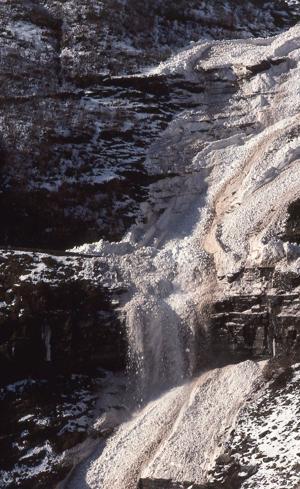
A river of snow, tumbling in blocks and smears, flowed over the road where the creek’s culverts crossed below it. Only the snow mass was higher than our heads, and spread 20 or 30 feet across the road before plunging like a dirty white waterfall off the ledge. It had been avalanching before we arrived, and kept flowing without any change in speed or volume for the half hour we stood there, amazed and photographing.
Most of the mountainsides around us were still green with grass and foliage. We couldn’t see the source of the snow, the catch basin that apparently gathered enough fall precipitation that it tore away an entire lane of the road months before the typical winter loads arrived. Mike’s and my first thoughts were how long it would last before we could continue our bike ride.
Ah, youth. Our second thoughts were how we would have survived had we gotten our acts together just half an hour earlier that morning — and biked around that corner before the slide started. This was 1990, when cellphones still required car batteries and urban infrastructure.
The visitor center at Logan Pass had been locked shut for weeks. The idea of having to bike over the pass and down the east side to St. Mary in hopes of finding a working phone where we could convince someone to drive 120 miles around the southern border of the park to bring us home — assuming we didn’t get blocked by another avalanche — daunted.
Why bother? Because it’s there? George Mallory quipped that about his persistent attempts to climb Mount Everest, shortly before his August 1924 expedition that claimed his life in a couloir below the summit. An adventurer friend of mine, Doug Ammons, claims that quote lacks context. The story told in the mountaineer circles Ammons frequents starts with a journalist interviewing Mallory at a party about why he endured the expense, hardships and risks of exploring the world’s highest peak.
Mallory spoke of the wonder of seeing extreme environments, the intellectual satisfaction of expedition logistics, and the comradery formed by a group dedicated to supporting one another in perilous circumstances. Yes, yes of course, the journalist replied. But in the end, all you’re doing is standing on a point on the map and then walking away.
You don’t stay there. You don’t take any treasure away. Why risk your life? “Because it’s there,” was Mallory’s frustrated response, probably with an unspoken (“you small-minded, sidewalk-bound, superficial twit”).
Like any esoteric pursuit, mountaineering tends to make one see others as initiates and ignoramuses. In the dictionary, means reverence, admiration or fear of something grand, sublime or extremely powerful. A growing body of medical research calls the experience of feeling awe vital for good health — an awesome a day keeps the doctor away.
Humans have an evolutionary history of identifying awe-inspiring things and building culture around them — through idolization, ritual interaction and protection. We put the bones of saints in jewel-encrusted boxes and bring them out for veneration on special days. We put the planet’s most unique spots inside lines on a map and go visit.
How we do that can consume the thing we adore. Shrines around the world have statues or totems worn shiny or even worn away by pilgrims who’ve come to touch the special spot for blessing, luck or other tradition. Usually a sacrifice of some sort is involved, even if it’s simply the effort to get to the spot.
And you get something in return, some sanctification that sets you apart from others who haven’t made the effort. You touch the beyond and leave a mark. You got there.
Biking to Logan Pass fits that fuzzy category. Remarkably, as of 2023 I haven’t seen any T-shirts or bumper stickers proclaiming, “I biked the Garden Wall. ” That’s despite knowing dozens of people who’ve done so, who in turn know dozens more and who can recount (often with a frustrated angst) how many hundreds of fellow bikers they now share the experience with.
Myself, I dedicated three more attempts at pedaling the Pass before turning the experience into an absurdity. To Logan Pass How do you keep your sanity during the Pandemic of 2020? My wife Magda and I did it by taking bike rides together in the fresh air, far from our virus-suspect fellow humans. Except to add insult to misery, the air of summer and fall 2020 got choked with wildfire smoke as well as disease.
We spent much of the summer riding up and down the hills around our home in Missoula getting in shape for a no-excuses try at Logan Pass. But on Oct. 8, the day we decided to go for it, a forest fire in Idaho was pumping PM 2.
5 fumes all across western Montana. Amid all the confusing directives about mask-wearing and social distancing, we brought face coverings to interact with the rangers as we entered the park. We also considered wearing them against the smoke on the ride up the Garden Wall.
It being hard enough to breathe while biking up a 7% incline for several hours, the added obstruction of a mask made us dizzy. We opted for lung damage. Shoulder seasons had gained considerably more popularity in the years since Mike Javorka and I first made a late-fall attempt.
Magda and I had to share the road with occasional cars, although none that came close enough to us to risk joining the disco shards. Still, it’s hugely intimidating to balance between a rock-strewn shoulder margin and a minivan full of bickering tourists with nothing but a windbreaker and a Styrofoam helmet for protection. We made it around the Loop, looked at Bird Woman Falls, took a breather at Haystack, and tried to catch a little refreshment at the Weeping Wall (which was feeling much better, apparently, with only a few tears on display).
Approaching Triple Arches, I hung back to get a photograph of Magda cycling over them. The sheer improbability of that fairy construction holding a road against towering cliffs of stone has always escaped me when viewed through a car window. Leaning against a rock guardrail, looking across a thousand-foot chasm at the tiny blue dot of Magda pedaling away, juxtaposed the immensity of the mountainside and the audacity of the engineering feat that tamed it.
Oct. 8 had been pleasantly warm up to that point. But 2 miles shy of the pass, the high-altitude winds pushed straight in our faces.
Although that last stretch only climbs about 300 vertical feet, the smoke, hours of exertion and wind piled up discouragement. We passed the Rimrock section where several hundred feet above, wary hikers took their first cliff-edge steps on the scariest bit of the Highline Trail. Then the final switchback by Oberlin Falls, and the huge sign signaling Logan Pass came into view.
We dismounted beside its rock plinth, grinning like Olympians. .
From: helenair
URL: https://helenair.com/news/state-and-regional/e-bikes-make-light-work-of-glacier-goal/article_5c6f31af-229d-5688-b6b6-45cb36376d6e.html