
Portable handheld PCs and mini-PCs are getting increasingly popular. These devices are based on mobile components that are predominantly used in laptops. At the same time, iGPU performance is constantly improving with ever more powerful SoCs.
Leading the way is AMD, whose current line of Zen 4 Phoenix processors allow the company to raise the bar even higher in terms of 3D performance. The Radeon 780M is the fastest iGPU available right now, thus putting AMD far ahead of Intel in integrated graphics. However, many modern games are already pushing the Radeon 780M to its limits.
The GPD G1 is here to tackle this issue. But first, you’ll need to make sure you have a device with a USB4 or an OCuLink port to be able to use the eGPU. The latter is natively supported by GPD’s own handheld devices (i.
e. 2023 version of GPD Win 4 ). The external graphics solution houses an AMD Radeon RX 7600M XT graphics chip with 8 GB of VRAM.
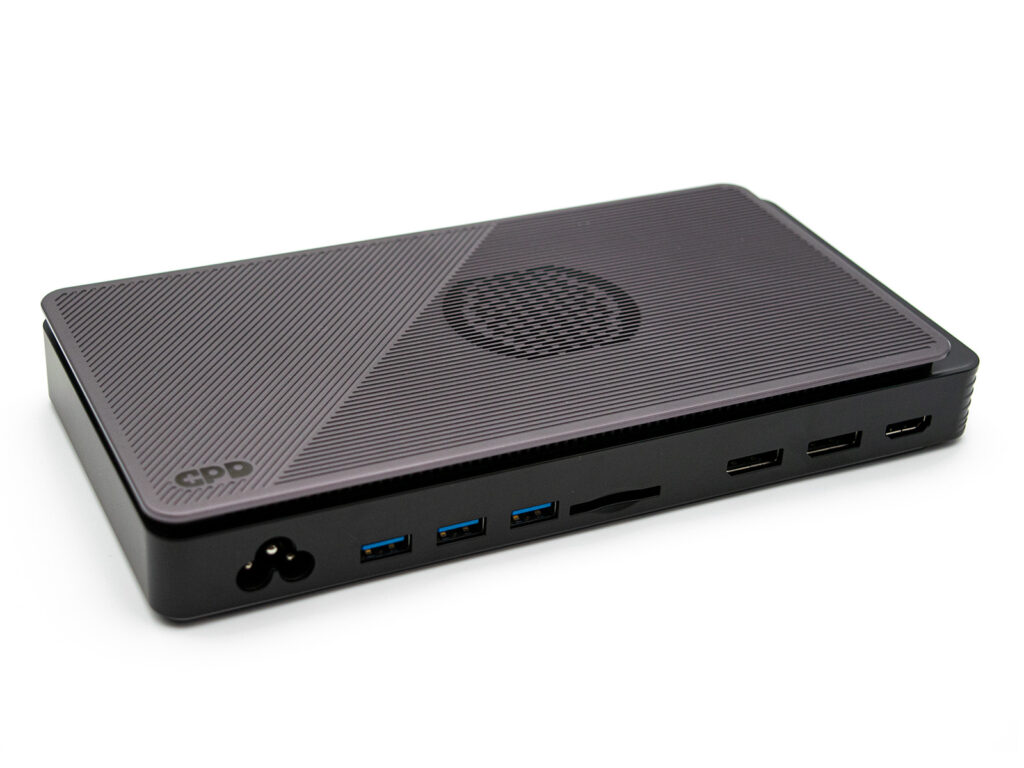
The manufacturer has also managed to pack everything into a relatively compact enclosure, including the power supply. The external GPU even offers additional external interfaces, such as USB ports and an SD card reader, and monitors can be connected to the device via DisplayPort or HDMI. Priced at €630 (US$655) before tax, the eGPU docking station is certainly no a steal.
Nevertheless, there is currently no comparable products of this size that can boost the 3D performance of mini-PCs or popular handhelds so easily and significantly. The box contents are fairly barebones: other than the eGPU, you’ll only find a power cord and a USB-C cable. Those who want to connect the GPD G1 using the faster OCuLink interface will require an additional cable.
Depending on the model, you can expect to fork out roughly another €50 (US$54) for an M. 2-2230 adapter and a suitable cable. GPD indicates that the G1 eGPU has a base clock speed of 2,023 MHZ but is capable of boosting up to 2,469 MHz.
During our testing, though, the device was almost always able to go beyond the boost clock. The mobile Radeon RX 7600M XT runs slightly slower than the desktop version of the Radeon RX 7600. The lower power draw is the fundamental reason for this decision.
That said, no concession had to be made when it comes to VRAM. Much like the the Radeon RX 7600, the GPD G1 features 8 GB of GDDR6 VRAM paired with a 128-bit memory bus. As a result, they both have the same memory bandwidth of 288 GB/s.
The GPD G1 eGPU can connect to a device via USB4 or OCuLink. We first used our GPU test system fitted with an AMD Ryzen 9 7950X to find out how the G1 stacks up against the desktop graphics cards in our testing. Because the Asus TUF Gaming X670E-Plus doesn’t have a native OCuLink interface, we had to resort to using an M.
2 adapter. At this point, we need to mention that the eGPU is only connected at PCIe 3. 0 speed despite having support for PCIe 4.
0. Using it with other M. 2 slots likewise didn’t yield higher data transfer rates.
As a point of reference, you can say that the 40 Gbps speed of USB4 is reached in this case. To have a direct comparison between USB4 and OCuLink, we also conducted additional tests by pairing the GPD G1 with a Minisforum UM780 XTX. The Minisforum mini-PC is one of the few devices on the market that are equipped with this interface.
In this combination, the GPD eGPU was able to showcase its full power with PCIe 4. 0 x4. We first compared the performance of the GPD G1 with various desktop graphics cards in order to check out how it measures up in an identical test system.
The mobile graphics chip in the GPD G1 is only around 20 percentage points behind its desktop counterpart ( AMD Radeon RX 7600 ). But this was to be expected owing to the lower power consumption. In contrast, our review unit is just 15% less powerful than an Nvidia GeForce RTX 4060.
AMD consistently performs well in benchmarks related to rendering performance. The GPD G1 likewise managed to produce a relatively good result. That said, the G1 doesn’t offer quite enough performance for professional use.
AMD has the PRO Series in their lineup for such applications, whilst Nvidia markets their professional graphics cards under the Quadro brand. You can certainly use the Radeon RX 7600 XT in the GPD G1 for smaller projects in a personal or semi-professional setting. It also supports the popular AV1 format for decoding and encoding videos.
The GPD G1 has great gaming performance and is largely better than a Radeon RX 6600 . Nonetheless, it is lacking somewhat in power to match the Radeon RX 7600 . Considering its performance, you shouldn’t expect to use the eGPU for anything more than Full HD gaming.
But it is good enough as an expansion for handheld PCs. Because the RX 7600M XT is paired with only 8 GB of VRAM, the eGPU may sometimes hit its VRAM limit when running games at max settings, resulting in relatively poor P1 values (1% low). The Radeon RX 7600M XT also supports ray tracing, though we can only say this is a good marketing gimmick.
In practice, enabling ray tracing reduces frame rates so much that it is no longer possible to game comfortably. Looking at the games tested, we see that the GPD G1 can mostly produce good frame rates at high presets. However, there was a major outlier in Ratchet & Clank: Rift Apart.
We weren’t able to get playable frame rates regardless of the preset selected. At the moment, we can’t entirely rule out the possibility that this is caused by driver issues. But when you consider how much the GPD G1 costs, the results obtained here are clearly not good enough.
Comparable desktop graphics cards in the price range would be something like the AMD Radeon RX 7800 XT and Nvidia GeForce RTX 4070 . To demonstrate the best performance you can get from the GPD G1, we ran additional benchmarks with the eGPU connected to the Minisforum UM780 XTX. This mini-PC features both USB4 ports and an OCuLink interface, which lets the Radeon RX 7600 XT operate at PCIe 4.
0 x4 speed. In direct comparison, it is very easy to see the performance difference between the two interfaces. With optimal connection, the mini-PC performs at a similar level to our GPU test system.
The OCuLink interface provides 16% more performance than USB4 thanks to its higher bandwidth. In terms of gaming performance, the GPD G1 is able to deliver much better results over OCuLink. At lower resolutions, we are already hovering around the bandwidth limit of the USB4 connection.
This is not the case when using the OCuLink interface. In other words, if you have the means to do so, you should definitely connect the GPD G1 using OCuLink in order to get the best performance from the device. GPD has placed a fan in the middle of the unit, which draws in air from the top and the sides.
This design is fundamentally sound and well-conceived. That said, you can definitely hear the fan running. Even at idle, we were already measuring 36 dB(A) of noise from the unit.
The eGPU reached as loud as 55. 7 dB(A) during the stress test – a level that can be described as annoying. Anyone who doesn’t have a pair of good headphones is going to keep hearing the graphics card running in the background.
The noise feels even louder because the fan produces a relatively high-pitch sound. We wish the GPD G1 had a considerably more effective cooling solution. Using an external power supply would perhaps have been a better option, as this would leave more space in the enclosure for a larger cooler.
Given the high noise level, it is safe to assume that the fan must work very hard to keep the GPU’s temperatures in check. The device does this fairly well in practice: we saw GPU temps of 73°C (163. 4°F) during the stress test.
But GPU hotspot temps did peak at 88°C (190. 4°F). The cooling unit is designed to direct air out of the case from the side.
This is also where we recorded the highest temperatures on the case. Moreover, the bottom gets substantially warmer, which suggests that GPD uses this surface for heat dissipation as well. When it comes to power consumption, the GPD G1 benefits from the use of a mobile graphics chip.
Up to 100 watts of power is allocated to the Navi 33 chip itself – a level consistently reached during our testing. According to our power meter, the eGPU alone had a peak power draw of roughly 130 watts, including the usage of other components and various power losses caused by the PSU. It is thus no wonder that the power requirements of the overall setup (the eGPU plus our GPU test system) are relatively low: around 260 watts when gaming and 245 watts during the stress test (FurMark).
These are decent numbers and as a whole slightly lower than what you need with an Nvidia GeForce RTX 4060. The GPD G1 supports Power Delivery at up to 60 watts over its USB4 port. With the GPD G1, we have taken a look at a slightly different kind of GPU in this review.
As an external graphics card, the device is limited in terms of use cases. There are certainly situations where it makes sense to use such an eGPU. But the question is whether you are willing to shell out the asking price.
This is because the GPD G1 is by no means a bargain at over €700 (US$750). You could perhaps overlook the hefty price if the product has the performance to match. But all you can expect from the card is the power of a Radeon RX 6600, which can be had for as low as €205 (US$220) depending on the model.
Of course, you need to factor in the price of an eGPU enclosure, but such products don’t usually cost more than €400 (US$430). Right now, the tiny form factor is one thing the GPD G1 has going for it. The device also natively supports OCuLink, which is a much faster interface.
This is a feature not found on current eGPU enclosures from Razer or Sonnet. That said, the device paired with the G1 also needs to have an OCuLink interface in order for you to get optimal performance. The Minisforum UM780 XTX is one of those rare mini-PCs with such a port, which enables a noticeably higher performance than a USB4 connection.
It thus remains to be seen whether other manufacturers are also going jump on this train and give their upcoming mini-PCs an OCuLink interface. The GPD G1 lets you effortlessly transform a tiny computer into a compact gaming system. But the performance doesn’t match the asking price at all.
GPD itself offers the GPD Win 4 (2023), a compact handheld system comparable with a Steam Deck. This device is likewise capable of connecting to the GPD G1 natively using OCuLink. Though at this point, you may ask yourself whether this setup is still portable at all, because it really isn’t any more.
Other than its compact form factor, the GPD G1 also brings additional interfaces to the table, such as USB ports, display outputs and an SD card reader capable of UHS-II speeds. That said, we really can’t sugarcoat things when it comes to noise level. The eGPU is simply too loud and distracting under load, hitting upwards of 55 dB(A) during out testing.
The company should consider using an alternative cooling solution. Another point of our criticism is the package contents – providing only a USB4 cable is not enough. Considering how much the product costs, an OCuLink cable should have been included as well.
The GPD G1 is currently available from Amazon for around €960 ( US$835 ). Prices and availability are subject to change. .
From: notebookcheck
URL: https://www.notebookcheck.net/GPD-G1-eGPU-review-External-AMD-Radeon-RX-7600M-XT-with-8-GB-of-VRAM-uses-USB4-or-OCuLink.780524.0.html