
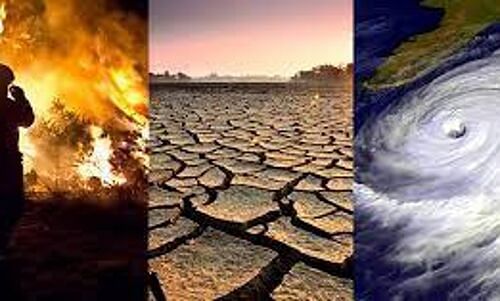
Tanuj GoswamiHe can be reached at tanujuri03@gmail. com) The world is facing the gravest danger of extinction and so far the awareness quotient created across the globe through different world forums to cope with the crisis is considered minuscule vis-à-vis the rate of damages being inflicted day in and day out. The frightening and negative effects of climate change have already caused enormous harm in terms of loss of human lives and property, diseases, human suffering by way of excessive heat waves, scarcity of drinking water, low productivity, increased salinity, and various natural calamities.
The list is endless and it is growing as so the all-pervading human sufferings in different parts of the globe. The effect of climate change is now palpable in every nook and cranny and many countries have been seriously battered interestingly most are the developing and least-developed states. The littoral states are confronting frequent coastal flooding with havoc menacingly disturbing their normal lives and even damaging the natural aquifers with the rising flow of coastal saline water.
The rapid glacial melting causes a rising of sea level in many coastal areas of the US, flooding the low areas and hampering day today human activities on the roads which get not only inundated but also make existing infrastructure infructuous because of the high intensity and frequency of floods and fury and accompanying sea-bearing pathogens. Similarly different regions of the world face different forms of climate change. All the changes are linked to the increasing level of Carbon dioxide and greenhouse gas emissions emanated from diverse human activities.
With every passing decade, the contours of climate change assume different forms and dimensions and its effect has been so fundamental that the approach to mitigate this danger has been extremely difficult but not impossible. The human intervention to reduce climate change must be a global effort, so collective action on a global scale can only work for effective mitigation. A report of the Intergovernmental Panel on Climate Change has found that the total anthropogenic GHG (Green House Gas) emissions were the highest in human history from 2000 to 2010.
The panel was also shedding light on the agriculture, forestry and other land-use sector (AFOLU) which account for a quarter of net anthropogenic GHG emissions -mainly from deforestation, emission from soil and nutrient management and livestock. However, it is heartening to note that there has been a slight decline in AFOLU carbon dioxide fluxes owing to increased afforestation and declining deforestation. The study also projected that there is a greater possibility of AFOLU turning into a net carbon sink in the long run.
In a highly eco-sensitive state like Assam-the massive fall out of uninterrupted deforestation and a kind of no holds barred indiscriminate use of fertilizers, harmful chemicals on agricultural fields, open mining, burning of fossil fuels and other innumerable causes are pausing serious concern. The State’s perennial problem of flood & erosion, gradual deceleration of precipitation, rising river beds, increasing drought situation, and soil infertility have threatened to impact the economy badly. The effect has undermined different components of the tourism sector also in terms of the decreasing footfalls, uncertain weather conditions, disruption of communication, transport, low income etc.
To ward off or diminish a range of human factors contributing to the climate change situation, the relevant institutions/NGOs/government agencies need to be equipped to respond effectively and adapt to changes. A case in point may be the State Forest Department. In the backdrop of serious climatic effects, the Assam Forest Department, of course, is an old hand, whose focus should be centred on working proactively and confronting the climate adversities by way of regenerative methods for carbon sink and eco-development through active involvement of local people.
The department requires a fresh bout of direction, imagination, and a strong motivational mindset and action in the field of conservation, preservation and regeneration of ecological processes of our deforested areas both in the hilly and plain areas. So sustainable development practices with economic benefits to the people are considered critically important for disaster risk reduction and effective adaptation. There is a trade-off between sustainable means of livelihood creation and disaster risk reduction in the long term.
The forest department is tasked with and mandated to protect and conserve natural resources with a clear-cut objective of checking deforestation and loss of biodiversity. In this respect whatever the department has been doing in the field is insufficient and even failed to make inroads in creating a sustainable livelihood or the self-sustenance aspect of the people living in or around the forest areas. The precious forest resources with exotic flora and fauna have still been plundered with gay abandon and many of which have become barren now and such vulnerabilities are proved to be the major drivers of disaster risk.
Again, the Department of Soil Conservation has its work cut out to restore the ecological balance, reduction of soil erosion, and water and soil moisture conservation. Further, it has set forth several objectives relating to agricultural production, land reclamation, afforestation, watershed development etc which need to be synchronized with the broader perspectives of managing the effects of climate change to be undertaken on an incremental basis as a state or national policy implementation. Recently the State government to improve Assam’s air quality and stop the use of fossil fuels has announced the Electric Vehicle (EV) Policy, 2021 has set a target of converting 100% of the public transport bus fleet and all the government vehicles into electric mode by 2030.
The government seized the moral high ground shifting the priority to ‘green and clean mode’ and so meeting the target and objective put forth in the policy will be a big step forward towards risk reduction. The need of the hour is to stop all kinds of skewed development processes leading to environmental degradation, unplanned urbanization, and poor governance and to integrate disaster risk management and mitigation process while policy decisions are taken and implemented at the state or national level. .
From: sentinel
URL: https://www.sentinelassam.com/editorial/grappling-with-the-disaster-in-the-making-598533