
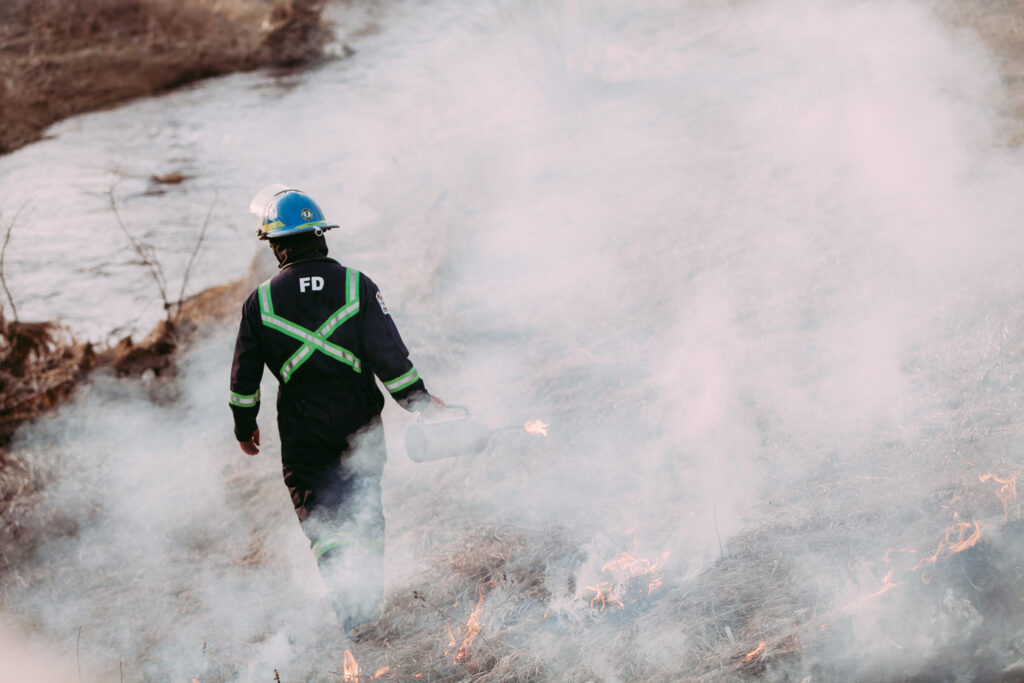
might seem counterintuitive, but this practice could save lives. Take southern New Jersey, for example, where there’s a 1. 1-million-acre (445,154-million-hectare) protected forest, the largest contiguous woodland in the 45-million-person hyper-city known as the Eastern Seaboard.
This forest is called Pinelands (or, alternatively, the Pine Barrens). Here’s a nightmare scenario: On a dry day in late spring, one of the many that spring up there takes off, outstripping firefighters’ efforts to contain it. Forty-mile-per-hour (64 kilometer-per-hour) winds out of the west send embers sailing miles ahead of the fire, igniting trees when they touch down.
The fire burns for as long as the winds blow, killing hundreds of residents and consuming billions of dollars’ worth of property. Advertisement Five hundred thousand people live in the Pinelands, jammed in among the trees of a forest that some have described as a conflagration waiting to happen, a fire that could make the record books as the worst wildfire in modern U. S.
history. The scenario described above isn’t unlikely; it’s the prediction of many experts. One of the suggested means to prevent forest fires is to fight fire with .
Some people are already doing it. One landowner in the Pinelands, for instance, burned roughly 1,000 acres (405 hectares) every year in his attempt to forestall a potential apocalypse [source: ]. But how can lighting small fires prevent bigger ones? Advertisement Controlled burning, sometimes called a “prescribed burn” or “suppression fire,” is an ancient practice used in all parts of the world to manage land.
Humans have started for at least a million years, and ever since then, we’ve put them to good use. In North America, for instance, historical sources, taken together with the record, appear to show that Indigenous peoples made extensive use of fire to drive out game and to clear savannas and prairies. Advertisement Europeans arriving in the 16th century brought their own traditions of controlled burning to create fields for grazing and cultivation.
Those that came from the northeast region of Europe were less exposed to prescribed burns, whereas those that populated much of the south tended to have extensive experience using fire as a tool to shape and manage the landscape to promote herding and hunting. Their approach happened to coincide with the practices deployed by the Native Americans they displaced, resulting in a continuation of the use of controlled burning in the South. After the Civil War, when wealthy northerners bought up many of the old plantations to use as hunting preserves, they brought their traditions of fire suppression with them.
But suppressing fires promoted the growth of a woody understory, which in turn led to the decline in the hunters’ favorite game: the bobwhite quail. Puzzled, the plantation owners began talking to government wildlife experts. These discussions led to a 1920s study headed by one Herbert L.
Stoddard. The problem, Stoddard concluded, was fire suppression. Stoddard’s published findings have since been identified as an important contribution to our understanding of the vital role fire plays in nature.
In fact, Stoddard became a passionate spokesman for the use of controlled burning, not only for the promotion of game hunting but for healthy forests [source: Johnson and Hale]. But Stoddard had many opponents, and it would be decades before controlled burning would receive mainstream recognition as the vital tool it has become. Advertisement Nowadays, foresters make extensive use of controlled burns, in part to promote healthier but largely to prevent large wildfires.
By lighting fires in the right places under the right weather conditions and with fire suppression tools on hand, experts can clear out the combustible understory material that leads to out-of-control wildfires. But even if controlled burning has the above-mentioned benefits, surely it’s bad for the environment. After all, burning releases particulate matter into the air, especially like carbon.
So controlled burning pollutes the air and contributes to , right? Advertisement Yes and no. Recent computer modeling studies have shown that wisely deployed controlled burning actually captures more carbon in trees than it releases. That’s thanks, in part, to the fact that old-growth trees trap far more carbon than younger, smaller growth.
Burning the little stuff helps the bigger stuff last longer and, therefore, hold onto more greenhouse gas. And, as previously mentioned, controlled burning helps prevent severe wildfires, which are big, bad emitters of carbon [source: ]. And there are other reasons for controlled burning, too.
Back in the 1960s, experts in Yosemite National Park were puzzling over the fact that there were no baby sequoias growing in the shadow of the giant elders. While these titans can live for thousands of years, they’re not immortal. They need to reproduce.
But they weren’t. One researcher, Dr. Richard Hartesveldt, suspected that fire might have something to do with it.
For decades, the park service had been diligently suppressing wildfires to help preserve the forest, according to their mandate. Hartesveldt experimented with small-scale controlled burns and discovered that his hunch was correct. Giant sequoias are highly fire-resistant.
They can easily survive low-intensity fires, and it turns out they desperately need those fires to reproduce. The heat opens up the sequoia cones and releases the seeds. By clearing out undergrowth, the fires uncover bare soil in which the seeds can germinate, and the new canopy gaps allow sunlight to reach the seedlings.
The park service now lights carefully supervised and controlled burns. [source: National Park Service]. Fire doesn’t just destroy; it helps regenerate.
Ring of Fire Around the world, every region with trees has a season when wildfires break out. Because of climate change, those seasons are getting longer everywhere. Between 1979 and 2013, the global fire season increased by 18.
7 percent. That creates an unfortunate feedback loop. The 864 million acres (349.
6 million hectares) of land that wildfires burn around the world each year can emit more than half of the amount of carbon that fossil fuels put into the atmosphere. Those increasing greenhouse gases trap more heat, leading to higher temperatures, fewer rainy days, faster winds and lower humidity. Those, of course, are precisely the conditions that ignite more wildfires.
The cost of dealing with the phenomenon is already being felt. In 2005, for example, Australia spent $9. 4 billion battling wildfires.
That was more than 1 percent of the entire country’s yearly economic output [source: ]. Advertisement There are a few with different purposes. Advertisement Step one: They plan.
They plan a lot. The “control” part of a controlled burn is key. After all, fire is a famously chaotic, destructive, often lethal force of nature.
Let it get away from you, and all hell could break loose. That said, with proper planning and execution, a controlled burn should go off well. Before the Burn They begin by consulting the local government branch in charge of forestry.
They know what regulations pertain, what permits are necessary and what time of year is best for burning in a given region. Spring is often the optimal time for controlled burning in many places since it tends to be the wettest season. Advertisement Next, whoever is conducting a burn must figure out exactly where it will take place and identify natural firebreaks (like roads or bodies of water).
They will then plow, mow or bulldoze additional firebreaks where needed to contain the fire. Assembling a crew — the bigger, the better — is a must. You need people to start the fires, to control them and to put them out.
Those in charge of a controlled burn need the appropriate equipment. Drip torches are the tool of choice for lighting things up. Various kinds of water sprayers, rakes, swatters, walkie-talkies and/or cell phones are also important to have on hand.
Crew members must have lots of drinking water nearby and must abstain from wearing any synthetic materials, including , which can melt and stick to skin when lit. Hard hats, eye protection and respirators are also recommended. The organizer of a controlled burn must keep a sharp eye on the weather in the days leading up to a burn.
Wind speed, humidity and temperature are all important factors when it comes to ensuring a safe burn. The Minnesota Department of Natural Resources, for instance, has recommended that burns should not take place when the wind is blowing more than 12 miles per hour (20 kilometers per hour), the humidity is under 25 percent and the temperature is above 80 degrees Fahrenheit (27 degrees Celsius). Burn Day Once everything is in order on a burn day, the crew often starts a small fire in a corner of the site that’s downwind to see how the flames act in the given conditions.
If all goes well, they can then light up something called a backfire. The backfire line is downwind against a firebreak. That means the only direction it can spread is against the wind, so it will move slowly and be easy to control.
Next comes the flank fire. As the name suggests, the flank fires are the sidelines. They burn in from their firebreaks at right angles to the wind, so they’ll burn more quickly than the backfire.
As the backfire and the flank fires burn, they consume the fuel in their paths, leaving an ever-widening firebreak behind them. Once this firebreak is large enough, the crew can ignite the headfire. The headfire burns with the prevailing wind direction, meaning it burns fast.
It’ll finish off the controlled burn, but thanks to big firebreaks created with the backfire and flank fires, it shouldn’t get out of control. Finally, when the burn is complete, it’s time to “mop up,” which means extinguishing any lingering flames or embers. That can mean cutting down any trees still on fire and using water to generally drench everything that’s still burning or smoking.
Advertisement Southern California is regularly in the news for devastating wildfires torching whole neighborhoods to the ground, so surely the state could benefit from controlled burning, right? That’s what fire managers thought for a long time. In their efforts to control the annual blazes, they frequently set fire to the chaparral, a dense, thorny, shrubby tangle of vegetation that covers the canyon sides. All that burning did absolutely nothing to lessen wildfires or mitigate the damage they caused.
Now researchers are beginning to understand why that is. Controlled burns help reduce the prevalence and impact of wildfires in certain kinds of forests where, if left to themselves, the woodlands will ignite every 10 to 15 years. Advertisement But chaparral isn’t that kind of vegetation.
When experts studied the geological record, they realized that, on its own, chaparral goes up in flames only once every 100 years or so. And when it does, it regenerates very slowly. So by regularly burning the chaparral, fire managers had inadvertently rid the landscape of natural, fire-resistant species and let , more flammable vegetation take its place [source: ].
In other words, in this particular case, controlled burning was counterproductive to a natural process. There is no general rule for how (and whether) controlled burning is beneficial. It all depends on the region.
Local species and weather determine what works best and where. Take, for instance, the computer modeling of carbon capture mentioned earlier. Those simulations were conducted in a northern Arizona forest.
The results don’t necessarily apply elsewhere. In fact, a forestry expert in Oregon doubts that a northeastern forest that’s managed with controlled burning would hold more carbon than one that wasn’t. While it seems that controlled burning carried out in southeastern woodland helps the atmosphere, the same cannot necessarily be said of other forests.
Nevertheless, controlled burns help the environment in other ways. By maintaining open canopies, fire can improve a forest’s structure and variety, making it more resilient to climate change [source: ]. Paradoxically, it seems we might be able to use this great, destructive force to mitigate the damage we’ve done to the ecosystem.
Advertisement.
From: howstuffworks
URL: https://science.howstuffworks.com/controlled-burns.htm