
Period poverty currently affects an estimated 500 million people across the world, particularly in low-income communities who cannot afford appropriate menstruation products. Addressing this issue is critical for fostering gender equality and ensuring that menstruation does not become a barrier to education, employment, or overall health. One way to do this is by making menstrual pads more sustainable with materials commonly found in the countries where the products will be used.
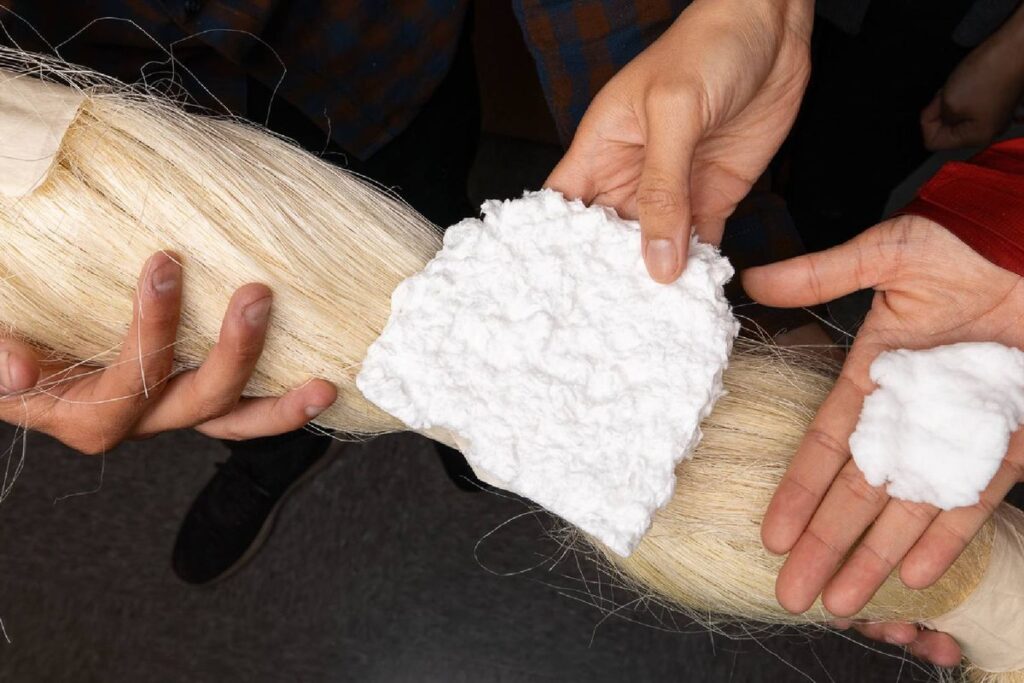
Using a common plant Researchers from Stanford have by using fibers from the readily available sisal plant, Agave sisalana, and transforming them into highly absorbent materials. “To open up access to local manufacturing, you have to think about where the raw materials will come from,” said Manu Prakash, an associate professor of bioengineering at Stanford and lead researcher of the new work. He added that, in Kenya, where his work is focused, “sisal is absolutely incredible.
” But finding the right fiber was not an easy or straightforward process. “We started mapping everything. We mapped bananas, we mapped water hyacinth, anything we could get our hands on,” Prakash said, adding that the aim was to develop a biodiversity map and a set of universal mechanisms that could be used in the development of high-absorption products.
That’s how the team stumbled on the sisal plant. Although the researchers were aware that it was a low-maintenance plant that thrived even in devastating drought years, no one had ever conceived of using it to develop the cellulose pulp that serves as the foundation for menstruation pads. However, it first needed to be altered to make it suitable for use in the hygiene products.
The first step was to develop a process to remove the lignin from the sisal fibers. To achieve this, Prakash and his colleagues decided to mimic the way termites break down wood. They then proceeded to use a blender to break the remaining macro cellulose fibers into microfibers.
This gave way to an absorbent airy material ideal for use in period products and consisting only of sustainable easy-to-make components. Open-sourced and replicable The team has now introduced the Plant Pad Consortium, an organization that is evaluating similar technologies and materials to generate a pad’s porous top and waterproof bottom layers without the use of dangerous expensive chemicals and with processes that can easily be replicated anywhere in the world, particularly in low-resource areas. The researchers have made all their procedures open-source so those who need them the most can have access to them.
They are also compiling a database of other plant-based materials and procedures that are being tested and show promise for the development of low-cost sustainable menstrual pads. “We’re trying to build this consortium so that we can, say, take a process discovered in my lab and implement it in Nepal, or use one of our labs to test an idea from an entrepreneur in Nigeria and help deploy it in a site in Kenya,” Prakash concluded. .
From: interestingengineering
URL: https://interestingengineering.com/innovation/plant-based-menstrual-pads-could-address-period-poverty