
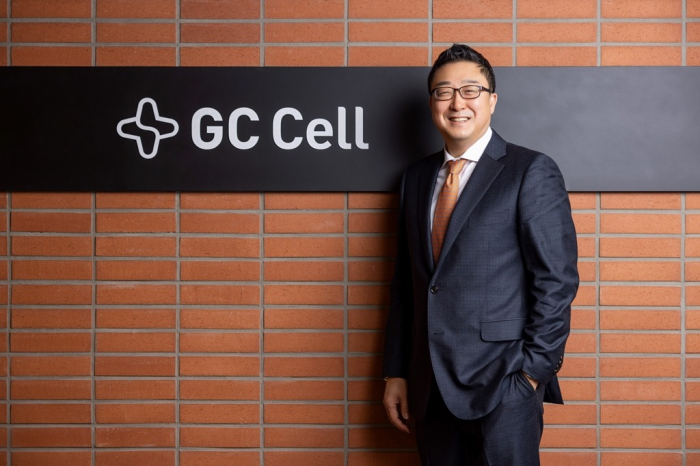
GC Cell Corp. , an affiliate of South Korea’s major pharmaceutical company GC Biopharma Corp. , aims to start the cell therapy contract development and manufacturing organization (CDMO) business for global bio-industry leaders while seeking the exports of its adjuvant therapy for liver cancer, its head said on Monday.
“We will accelerate the cell therapy CDMO business to grow into a global company,” GC Cell President and CEO James Park told The Korea Economic Daily in an interview. Park handled the global sales of Samsung Biologics Co. , the world’s top contract manufacturing organization, before joining GC Cell in January.
He played a key role in securing orders from the world’s 20 largest multinational pharmaceutical companies at Samsung. GC Cell is set to focus on the Chimeric antigen receptor (CAR) T-cell therapy, a type of cancer immunotherapy treatment that uses immune cells called T cells that are genetically altered in a lab to enable them to locate and destroy cancer cells more effectively. “Only one out of six CAR T-cell therapies sold in the US are available in Korea because of strict manufacturing conditions,” Park said.
“Demand for CAR T-cell CDMO in Asia is pretty strong among global major pharmaceutical companies. ” The CAR T-therapy, a customized medicine produced with patients’ blood, is regarded as a future anticancer drug as it kills cancer cells like guided missiles. The therapy is produced through complicated manufacturing processes and administered after rigorous quality tests.
Novartis’ Kymriah, the only CAR T-cell therapy available in South Korea, is manufactured in its plant in the US state of New Jersey with the blood of patients in the Asian country sent there. Johnson & Johnson Innovative Medicine won the approval for its CAR T-cell therapy Carvykti in March from the South Korean authority, but the company formerly Janssen Pharmaceuticals has yet to sell it. “Multinational pharmaceutical companies had planned only one or two CAR T-cell therapy plants before,” Park said.
“But they now plan to have production bases in various countries as the market of CAR T-cell therapy, a tailored medicine, is growing. ” GC Cell is competitive enough for the business as it has been producing its Immuncell-LC, a patient-derived autologous T-cell immunotherapy for liver cancer, Park said. Immuncell-LC, a customized anticancer drug made from a patient’s blood, received approval for liver cancer immunotherapy from South Korea’s Ministry of Food and Drug Safety in 2007.
It also secured the US Food and Drug Administration’s orphan drug designation for the treatment of liver cancer, brain tumors, and pancreatic cancer. The treatment has been used for about 10,000 patients so far without adverse reactions. “Immuncell-LC is not much different from CAR T-cell therapy,” said Park.
“Multinational pharmaceutical companies showed interest as we have produced a high-quality cell therapy and won approvals. ” GC Cell has an Immuncell-LC production capacity for some 2,000 patients a year, he said. “We expect to win deals next year since we have contacted all big pharma names with CAR T-cell therapy.
” The company is also seeking license out of the drug to the US and Europe, he said. Immuncell-LC raised the survival rates of liver cancer patients, according to the results of clinical trials. The rate for the group of Immuncell-LC patients without a relapse for 24 months after hepatectomies stood at 72%, while the rate of the placebo group was 54%.
About 50-70% of liver cancers relapse after the surgical treatments. “Demand for Immuncell-LC keeps growing although new drug demand usually declines after being sold for more than 10 years,” Park said. “Multinational pharmaceutical companies are interested in technology transfer of the drug.
” GC Cell generated sales of 30. 7 billion won ($23. 3 million) from Immuncell-LC last year, about two-thirds of its total revenue of 46.
4 billion won. Yoo-Rim Kim at.
From: kedglobal
URL: https://www.kedglobal.com/bio-pharma/newsView/ked202312120007