
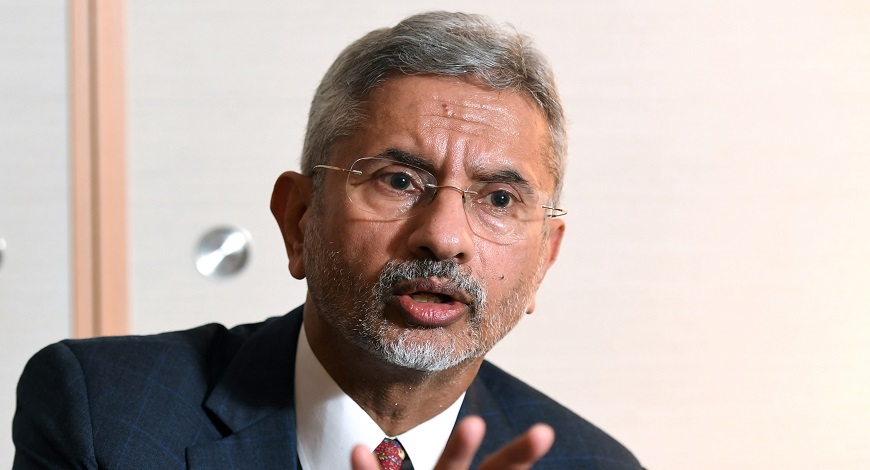
External Affairs Minister S Jaishankar outlined India’s digital progress on Monday, emphasising the success of the Digital Public Infrastructure (DPI) in democratising technology. At the 8th Global Technology Summit (GTS) in New Delhi, Jaishankar pointed out that India is rapidly catching up in technology adoption, citing the massive volume of UPI transactions as evidence of how readily people embrace technology when it becomes available. “Effort in building and delivering on Digital Public Infrastructure (DPI) is what the Prime Minister calls democratising technology.
Today, the average person not only uses it but also relates to it. The figures that we like to tout out the massive volume of UPI transactions show how readily people take to technology once it is on offer,” the EAM said. “India is playing catch up in many areas because while our era of reforms started three decades ago, the era of reform was not necessarily the era of technology,” he said.
Responding to a question about re-globalisation, Jaishankar emphasised the importance of dispersed production in a truly globalised economy. “A globalised economy doesn’t mean production gets done at the centre and everyone else is a consumer. A globalised economy means dispersed production,” Jaishankar added.
The EAM also touched upon the enduring relationship between India and Russia, spanning close to six decades. “We have a relationship with Russia and it is not a relationship that happened in an instant. It is a relationship of close to 60 years… I see a problem defined in a way as though somewhere there’s some handicap that India has by having this relationship,” Jaishankar said.
He also justified the strong ties between the two nations, citing geopolitical factors and the first principle of the politics of “your neighbour’s neighbour” on the Eurasian landmass. “But this relationship has saved us many times… If you look at the Eurasian landmass, it makes sense that India and Russia would have strong relations because it is in accordance with the first principle of politics of your neighbour’s neighbour,” the EAM noted. Turning to the global stage, Jaishankar highlighted the growing interest of many countries in mobility discussions, recognising the interconnectedness of technology and mobility in today’s world.
“Many more countries are interested in mobility discussions because the world of technology is also accelerating the world of mobility. I know that there’s a lot that you will all be discussing at the moment,” he said. “In terms of the policy challenges, there is the need to regulate technology because many technologies also come with their downsides and we have seen that expressed in world affairs through regimes, treaties and rules, and there are some that are very obvious, as we’ve seen,” he added.
The eighth edition of the Global Technology Summit (GTS) is being held in New Delhi from 4-6 December. The Global Technology Summit (GTS) is India’s flagship event on geo-technology, co-hosted by the Policy Planning and Research Division of the Ministry of External Affairs and Carnegie India. The theme of this year’s Summit is “Geopolitics of Technology,” MEA said in the press release.
More than 40 public sessions, keynote addresses, ministerial addresses, panel discussions, book launches, and other related events will be held during the Global Technology Summit (GTS). Speakers and participants, including policymakers, industry experts, academics, technocrats and innovators from India and around the world, will attend the summit. Ministers and senior government officials from several nations, including India, the US, Singapore, Sri Lanka, Kenya, Germany, Sierra Leone, Brazil and Lithuania.
(ANI).
From: businessworld
URL: https://www.businessworld.in/article/Technology-Plays-an-Important-Role-In-Shaping-Human-Progress-Says-Foreign-minister-Jaishankar/05-12-2023-501061