
SportsMoney The Big Ten And SEC Are Clearly In Charge. Where That Leaves The Rest Of College Sports Is In Serious Doubt. Karen Weaver Contributor Opinions expressed by Forbes Contributors are their own.
I cover the intersection of college sports and higher education New! Follow this author to stay notified about their latest stories. Got it! Aug 18, 2022, 08:09pm EDT | New! Click on the conversation bubble to join the conversation Got it! Share to Facebook Share to Twitter Share to Linkedin INDIANAPOLIS, INDIANA – DECEMBER 04: Head coach Jim Harbaugh of the Michigan Wolverines celebrates . .
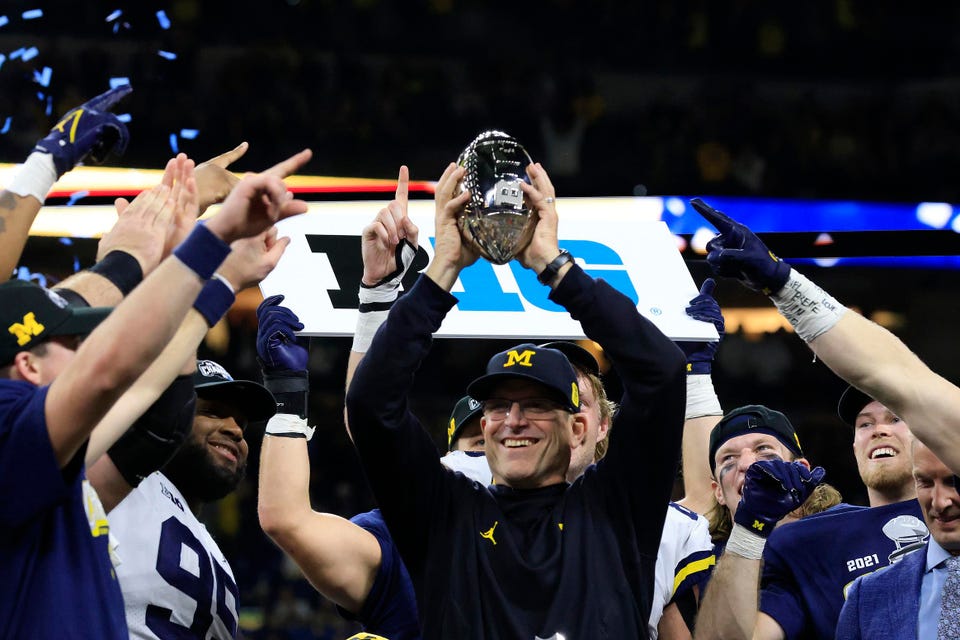
. [+] winning the Big Ten Football Championship game against the Iowa Hawkeyes at Lucas Oil Stadium on December 04, 2021 in Indianapolis, Indiana. (Photo by Justin Casterline/Getty Images) Getty Images There were two news items this week that will have enormous impact on the fast changing landscape of college athletics- one you saw and one you may have missed.
The first, the Big Ten’s gargantuan $1 billion, seven year media rights deal with Fox, FS1, CBS, NBC and Peacock has shaken the landscape to its core. The reach of these platforms covers every home in America in some fashion. When you compare this massive dissemination of games, it makes the Pac-12’s past troubles with distribution via DirectTV look absolutely absurd.
The second item of note is the trial balloon floated by SEC Commissioner Greg Sankey over the future of both the College Football Playoff (CFP) and the men’s basketball postseason. While much discussion has already filled the inboxes of college sports insiders regarding the future of the CFP, it should be alarming to some what Sankey told SI about March Madness: “If the last team in can win the national championship, and they’re in the 30s or 40s from an RPI or NET standpoint, is our current approach supporting national championship competition? I think there’s health in that conversation. That doesn’t exclude people.
It goes to: how do we include people in these annual national celebrations that lead to a national champion?” Seems like an innocuous observation on the surface but, as The Athletics’ Dana O’Neill wrote , “ever heard of the wolf in sheep’s clothing?” Sankey’s question mirrors his thinking and is likely rooted in his reality, but is not a good sign for the rest of college athletics. Here’s why. KNOXVILLE, TN – SEPTEMBER 02: SEC commissioner Greg Sankey looks on during a college football game .
. . [+] between the Bowling Green Falcons and Tennessee Volunteers on Sept.
2, 2021 at Neyland Stadium in Knoxville, Tennessee. (Photo by Joe Robbins/Icon Sportswire via Getty Images) Icon Sportswire via Getty Images Sankey’s SEC conference job, like Kevin Warren’s in the Big Ten (and the remaining Power 5 commissioners), requires him to look out for his teams. His job is to move the needle (and the national conversation) around what works best for his campuses.
For schools that have both the wealth and the TV brand to generate iconic non-conference mid-week match-ups, that continues to matter in the strength of schedule indexes. It’s why Sankey is implying the obvious—we should only invite the VERY best teams to compete for a men’s basketball championship. MORE FOR YOU WWE Extreme Rules 2021 Results: Winners, News And Notes As Roman Reigns Beats The Demon The World’s Highest-Paid Soccer Players 2021: Manchester United’s Cristiano Ronaldo Reclaims Top Spot From PSG’s Lionel Messi The Good, Bad And Ugly From The Green Bay Packers’ Win Over The San Francisco 49ers Sankey now has 16 mouths to feed, and despite the misnomer that SEC football is the only thing that counts, it’s incumbent upon him to get as many teams into the post season (any postseason) as he can.
With a current field of 68 teams, the obvious answer would be to add more rounds and teams. But as we’ve observed in the raiding of USC SC and UCLA by the Big Ten, does that add value (i. e.
additional media dollars and eyeballs) to what is arguably one of the best sporting events on the planet? I don’t know-ask Cal or Stanford about that metric. Where does that leave ‘Cinderella’? A lot has been written about the longtail benefits for an entire institution of a magical run through the tournament (see: Saint Peter’s ), and many Division I conferences are built as “basketball centric” conferences, trying to advance at least one team into the playoffs in order to earn monetary “units” for the rest of the group. If it’s next to impossible to qualify for the postseason because a school doesn’t have the RPI, the resources (or brand) to travel and play high profile opponents, what chance do they have to qualify for The Big Dance? Under Sankey’s “healthy conversation”, not nearly as many Cinderellas would qualify.
Why should these elite media organizations share ANY of the basketball postseason revenues with programs outside of their exclusive invitation-only event? When your job as commissioner is to do what’s best for your teams, it makes perfect sense. I’m in Division II or III-why should I care about what Greg Sankey thinks? Here’s why. If the basketball post season evolves into a Big Ten-SEC invitational (with the ACC and Big 12 teams qualifying as “at-large” invites), it’s clear where that leaves many (not all) Division I basketball schools (note: good, quality teams who play in conferences modestly funded by media dollars): on the outside.
Divisions II and III schools should be on high alert. Funding for post-graduate scholarships, minority internships, grants, and yes, even funding for your NCAA championship tournaments, which all come from March Madness, could disappear. It’s the $53 million and the $36 million question campus leaders in Divisions II and III should immediately be asking themselves.
Poof. Frustratingly, the outcome is not in your control. It was painfully obvious with the arm twisting that happened at the January Convention.
If you read the tea leaves, clearly something is amiss. Two large warning signs went up this week-one obvious and the other staggering. It might be time for a Plan B.
Follow me on Twitter or LinkedIn . Check out my website or some of my other work here . Karen Weaver Editorial Standards Print Reprints & Permissions.
From: forbes
URL: https://www.forbes.com/sites/karenweaver/2022/08/18/the-big-ten-and-sec-are-clearly-in-charge-where-that-leaves-the-rest-of-college-sports-is-in-serious-doubt/