
Credit with another milestone in space exploration: On February 12, 2001, a spacecraft landed on the surface of an asteroid for the first time in history. After a year orbiting the asteroid 433 Eros, the Near Earth Asteroid Rendezvous (NEAR) spacecraft made a controlled descent to the surface. But what exactly are ? And what was the NEAR Shoemaker mission about? Advertisement In 1772, a mathematician named Johann Titus and an astronomer named Johann Bode discovered a mathematical sequence that explained the distances from the sun of all the known planets — but there seemed to be one missing.
Titus’s series predicted the possibility of a planet orbiting between and at 2. 8 AU (2. 6 x 10 mi / 4.
2 x 10 km) from the sun. AU stands for astronomical unit and is based on the mean distance from to the sun, 9. 3 x 10 miles (1.
5 x 10 km). Advertisement Astronomers began to search for this missing planet, and in 1801, an Italian astronomer named Giuseppi Piazzi found a faint body at that distance that he called Ceres. However, Ceres was fainter than Mars or Jupiter, so Piazzi concluded it was much smaller.
Astronomers later found other small bodies in this same vicinity. These objects were named asteroids (meaning star-like). They are also called minor planets.
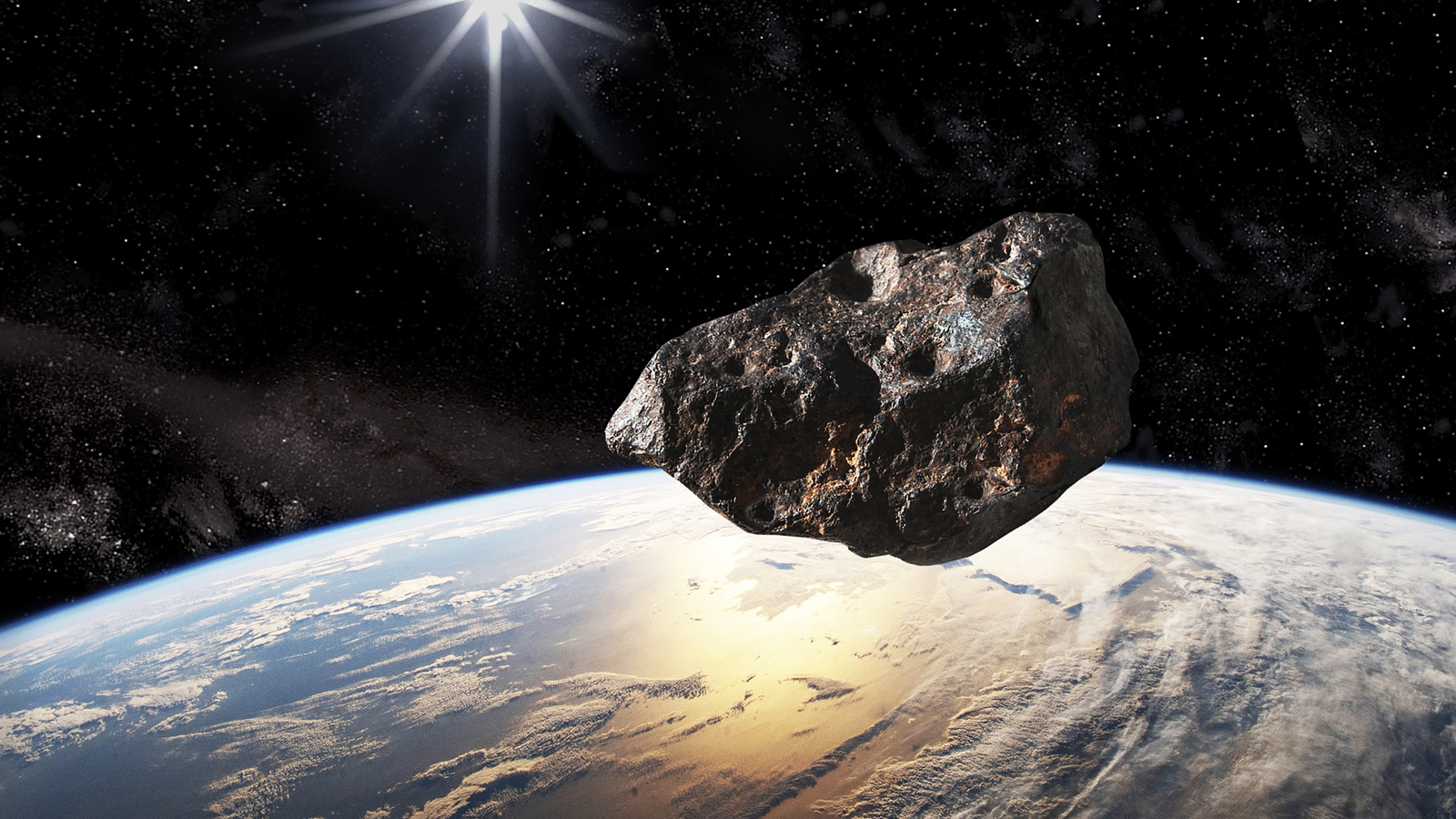
Upgrading Space Rocks In 2006, Ceres was promoted from asteroid to , due to its relatively massive size. Nine years later, landed on the dwarf planet, making Ceres the first of its kind to receive such an honor. Advertisement Asteroids are small, rocky bodies that orbit the .
Most asteroids occupy the main asteroid belt between the orbits of and Jupiter, which is anywhere from 2. 1 AU (1. 95 x 10 miles or 3.
15 x 10 kilometers) to 3. 2 AU (3. 0 x 10 miles or 4.
8 x 10 kilometers) from the sun. There are more than 1 million known asteroids [source: ]. They are irregularly shaped and vary in size from a radius of 33 feet (10 meters) to several hundred kilometers (Vesta is the largest, with a radius of 329 miles or 530 kilometers).
By measuring fluctuations in their brightness, we know that many asteroids rotate in periods of three to 30 days. Advertisement Scientists classify asteroids by their composition. Asteroids appear to be of two different origins: Advertisement We think that asteroids are the remains of planetesimals, early pieces of the , formed between Mars and Jupiter.
Some planetesimals began forming into planets, but Jupiter’s immense gravitational force smashed them apart. Others did not start to form planets (for unknown reasons). Jupiter’s gravity continues to impact asteroid orbits.
Occasionally, it pulls an asteroid out of the main asteroid belt, sending it into the solar system. These stray asteroids may collide with planets or, in the case of what are called Trojan asteroids, share an orbit with a larger planet. NASA monitors asteroids that cross Earth’s orbit to protect Earth from a possible asteroid impact.
(In fact, NASA’s DART ( ) mission tested our ability to deflect an asteroid and alter its path, then successfully did so in 2022. ) Advertisement Project NEAR was the first spacecraft to orbit a small body of the solar system. It was launched in February 1996.
NEAR flew by the asteroid Mathilde in June 1997, coming to within 753 miles (1,212 km) of the surface. It continued on its journey to eventually orbit the asteroid 433 Eros in February 2000. Eros is one of the largest asteroids, discovered by Gustav Witt and August Charlois in 1898.
Eros is potato-shaped and is 21 miles (33. 8 km) long, 8 miles (12. 9 km) wide and 8 miles thick.
It rotates every five hours and orbits the sun at about 1. 5 AU (1. 4 x 10 mi / 2.
25 x 10 km). Eros is an S-type asteroid. Advertisement NEAR orbited Eros for almost a year, passing as close as 4 miles (6 km) and as far as 300 miles (500 km) from the surface.
During this time, it measured the asteroid’s gravity, photographed the asteroid and mapped and made chemical measurements of the surface. After a year in orbit, NEAR landed on the surface of Eros in February 2001, becoming the first spacecraft to land on an asteroid. NEAR spent two weeks collecting and sending back data before the extreme cold destroyed its communication capabilities — the temperature on Eros is about minus 279 degrees Fahrenheit (minus 173 degrees Celsius) [source: ].
Advertisement.
From: howstuffworks
URL: https://science.howstuffworks.com/dictionary/astronomy-terms/asteroid.htm