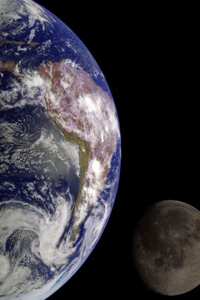

Gravity is a force that we experience every day, yet it remains somewhat of a mystery. It’s the reason we stay grounded on and why objects fall when dropped. Although there are several theories attempting to explain gravity, scientists still don’t completely understand it.
In this article, we will answer the question, ” ” by exploring Newton’s and Einstein’s theories of gravity, discussing more recent views and touching on the role of gravity in our solar system and everyday life. Advertisement In the 1600s, an English physicist and mathematician named was sitting under an apple tree — or so the legend tells us. Apparently, an apple fell on his head, and he started wondering why the apple was attracted to the ground in the first place.
Newton publicized his Theory of Universal Gravitation in the 1680s. It basically set forth the idea that gravity is a predictable force that acts on all matter in the universe, and is a function of both mass and distance. The theory states that each particle of matter attracts every other particle (for instance, the particles of “Earth” and the particles of “you”) with a force that is directly proportional to the product of their masses and inversely proportional to the square of the distance between them.
Advertisement So the farther apart the particles are, and/or the less massive the particles, the less the gravitational force. The standard formula for the law of gravitation goes [source: ]: where is the , and are the masses of the two objects for which you are calculating the force, and is the distance between the centers of gravity of the two masses. G has the value of 6.
67 x 10 dyne * cm /gm . So if you put two 1-gram objects 1 centimeter apart from one another, they will attract each other with the force of 6. 67 x 10 dyne.
A is equal to about 0. 001 gram weight, meaning that if you have a dyne of force available, it can lift 0. 001 grams in Earth’s gravitational field.
So 6. 67 x 10 dyne is a miniscule force. When you deal with massive bodies like the Earth, however, which has a mass of 6 x 10 kilograms (see ), it adds up to a rather powerful gravitational force.
That’s why you’re not floating around in space right now. The force of gravity acting on an object is also that object’s weight. When you step on a scale, the scale reads how much gravity is acting on your body.
The formula to determine weight is [source: Kurtus]: where m is an object’s mass, and g is the acceleration due to gravity. Acceleration due to gravity on Earth, is 9. 8 m/s² — it never changes, regardless of an object’s mass.
That’s why if you were to drop a pebble, a book and a couch off a roof, they’d hit the ground at the same time (unless the roof is really high, in which case comes into play). For hundreds of years, Newton’s theory of gravity pretty much stood alone in the scientific community. That changed in the early 1900s.
Advertisement , who won the Nobel Prize in Physics in 1921, contributed an alternate theory of gravity in the early 1900s. It was part of his famous General Theory of Relativity, and it offered a very different explanation from Law of Universal Gravitation. Einstein didn’t believe gravity was a force at all; he said it was a distortion in the shape of space-time, otherwise known as “the fourth dimension” (see to learn about space-time).
Advertisement Basic physics states that if there are no external forces at work, an object will always travel in the straightest possible line. Accordingly, without an external force, two objects traveling along parallel paths will always remain parallel. They will never meet.
But the fact is, they do meet. Particles that start off on parallel paths sometimes end up colliding. Newton’s theory says this can occur because of gravity, a force attracting those objects to one another or to a single, third object.
Einstein also says this occurs due to gravity — but in his theory, gravity is not a force. It’s a curve in space-time. According to Einstein, those objects are still traveling along the straightest possible line, but due to a distortion in space-time, the straightest possible line is now along a spherical path.
So two objects that were moving along a flat plane are now moving along a spherical plane. And two straight paths along that sphere end in a single point. Advertisement More recent theories of gravity express the phenomenon in terms of particles and waves.
One view suggests that particles called gravitons cause objects to be attracted to one another. However, gravitons have never been observed. Another theory involves gravitational waves or gravitational radiation, generated when an object is accelerated by an external force.
Although gravitational waves have not been directly observed, their existence has been confirmed through indirect evidence. Advertisement Gravity plays a crucial role in the formation and stability of our solar system. It assisted in forming the universe, keeps the moon in orbit around the Earth, and prevents Earth from hurtling into the sun.
The gravitational pull of the sun keeps all the in their orbits, and the gravitational attraction between planets and their moons keeps the moons in orbit. Advertisement Gravity Varies Across Earth’s Surface The force of gravity is not the same everywhere on Earth. It is slightly weaker at the equator due to the centrifugal force caused by Earth’s rotation and the fact that the Earth is not a perfect sphere but an oblate spheroid.
Gravity is stronger at the poles and weaker at higher altitudes. This variation is why your weight can change slightly if you travel from one location to another on Earth’s surface. Gravity and Black Holes A black hole is a region of space where the gravitational pull is so strong that not even light can escape from it.
The point of no return around a black hole is known as the event horizon. Once an object crosses this boundary, it is inevitably pulled into the black hole. The center of a black hole, where all of its mass is concentrated, is called the singularity.
Advertisement Gravitational Constant The gravitational constant (G) is a fundamental constant in physics that describes the strength of the gravitational force between two objects. It has a value of approximately 6. 67430(15) x 10 Newtons (m /kg ).
Gravity and Everyday Objects The gravitational attraction between everyday objects, like a book and a pen, is incredibly weak because their masses are so small. However, the cumulative effect of Earth’s gravity is what keeps everything anchored to the ground. Fundamental Forces Gravity is one of the four fundamental forces of nature, along with electromagnetic forces, the strong nuclear forces, and the weak nuclear forces.
It is the weakest of the four forces, yet it has an infinite range and is responsible for the large-scale structure of the universe. Advertisement While we have made significant progress in understanding gravity, it remains a fascinating and somewhat mysterious phenomenon. Whether it is the force that keeps us grounded, the reason planets orbit the sun, or the subject of groundbreaking scientific theories, gravity is a fundamental force that shapes our universe and everyday lives.
Advertisement.
From: howstuffworks
URL: https://science.howstuffworks.com/environmental/earth/geophysics/question232.htm