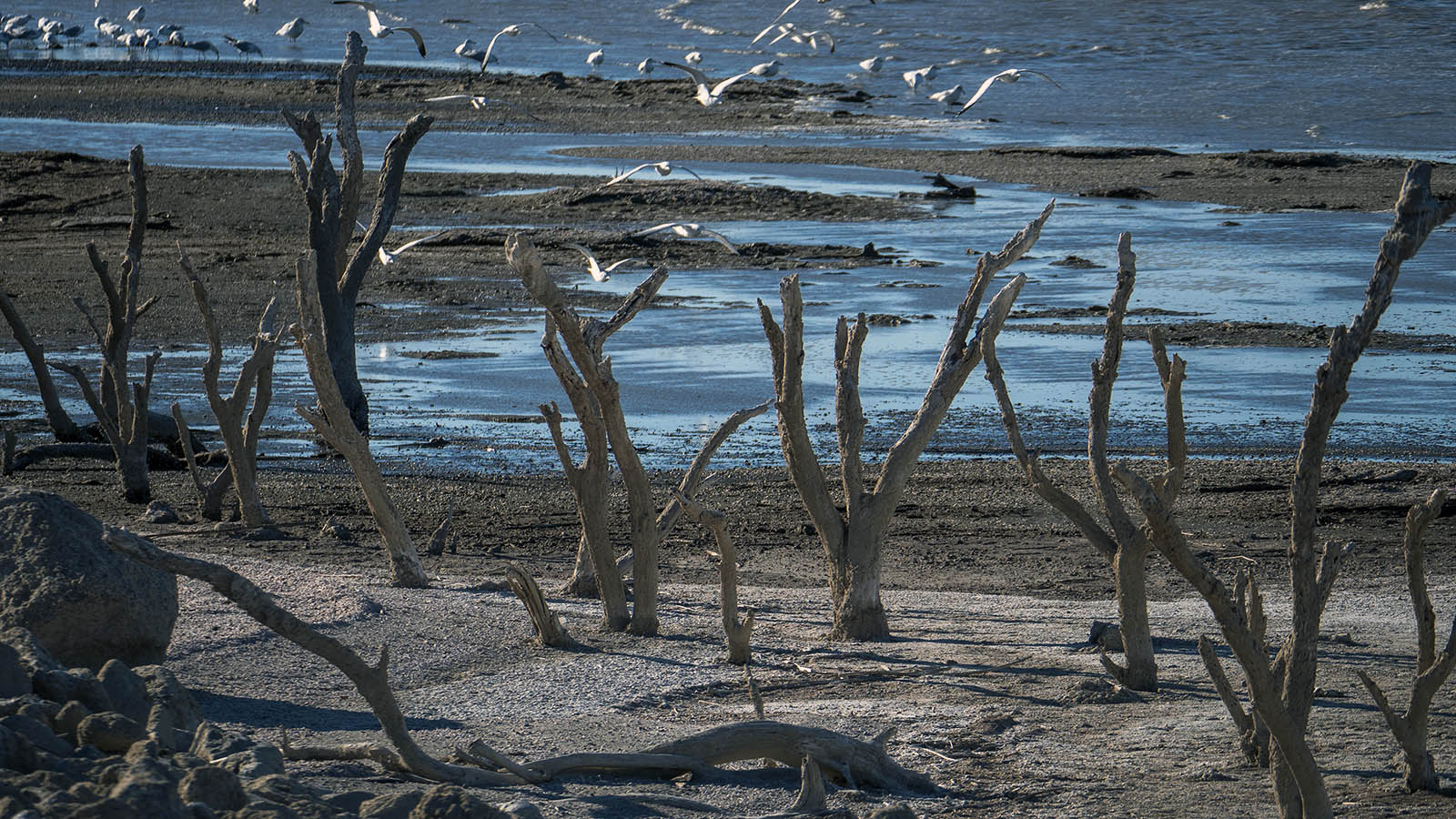

California’s largest inland lake, the , lies in the Imperial and Coachella valleys in Riverside County and Imperial County. The lake, which is more than 50 percent saltier than the Pacific Ocean, is becoming more salt than water because it’s essentially evaporating. The lake and the area that surrounds it — once hotspots for tourism and wildlife — have essentially become ghost towns.
Advertisement But while people no longer visit, the lake’s evaporation still has consequences for both humans and animals. Rates of asthma there are disproportionately high and thought to be caused by dust blown up from the dry lakebed. Meanwhile fish populations as are populations of .
So, what is happening at the Salton Sea and is anything being done about it? The Salton Sea has existed in over millennia, depending on changing flows of water from the nearby Colorado River. It’s located in the Salton Basin near the , and geologic evidence shows it has alternated between mostly freshwater, mostly saltwater and nearly dry. The sea was in a dry phase when in 1905, the Colorado River overflowed, and, due to human error, breached its , flooding the desert valley for two years.
This created the (1,036-square-kilometer) inland lake, which was larger than Lake Tahoe. Advertisement , locals decided to divert agricultural irrigation runoff to the lake, which kept it alive longer than it probably would have on its own, given it’s located in a desert where temperatures frequently soar above 100 degrees Fahrenheit (37 degrees Celsius). This accidental lake turned out to be , though.
Birds flocked to the area, and various fish species seemed to thrive there as well. In 1930, the U. S.
Fish and Wildlife Service created the to protect the ducks, geese and shore birds attracted to the lake. The Salton Sea area continued to thrive in the 1940s and ’50s. Tourism grew, and developers branded it the “Salton Riviera,” building hotels, homes and yacht clubs.
Salton Sea State Park opened in 1955, then the second largest state park in California. The California Department of Fish and Game bred saltwater fish in the lake — and they flourished and fed large populations of migratory birds. But this desert paradise’s days were numbered and by the 1970s, the “Salton Riviera” was headed for trouble.
Advertisement Because of the lake’s desert location, it has never gotten much precipitation. Plus, most of the surrounding activity was agricultural, so the lake experienced high levels of pesticide and fertilizer runoff. And because the lake has no outlet, the poisoned water had nowhere to go.
This caused a process called , which results in increased algae and bacteria known as . This perfect storm of conditions caused the lake to become saltier. The high salinity, along with the eutrophication, caused massive fish die-offs.
Advertisement By the 1990s, dead fish littered the shores of lake. And on the Salton Sea between December 1991 and April 1992. Another 20,000 died in 1994.
By 1996, and nearly 10,000 other fish-eating birds. More than 1,000 endangered brown pelicans died in the largest reported die-off of an endangered species. Eight million tilapia died in one day in the summer of 1999.
Tourism dropped off. The lake level dropped, too, due in part to evaporation and in part, ironically, to a reduction in the same agricultural runoff that had caused so many problems in the first place. Advertisement , things became even more dire.
Southern California’s water districts finally signed off on the Quantification Settlement Agreement (QSA) that had been in negotiation for years. It called for a large portion of the Colorado River water that had gone to the Imperial Valley for farming irrigation to be redirected to urban areas in the Coachella Valley and San Diego for residential use. To make up for that water loss, the agreement designated a water restoration plan for the Salton Sea for 15 years.
It also paid farmers in the Imperial Valley to leave some of their land fallow, so the water they would have used for agriculture would go the Salton Sea instead. Advertisement But that deal ran out Dec. 31, 2017, so the lake continued to dry up.
Even before the QSA deal expired, the Salton Sea ran into problems. In 2012, a sulfurous smell wafted across hundreds of miles of Southern California. The odor turned out to be from the lake’s rotting fish carcasses.
In addition, the dry lake bed left large swaths of dirt that was once covered by water exposed like a massive beach. “That [exposed dirt] has the potential to be moved by wind and increase the amount of dust that’s in the air,” says Jill Johnston, Ph. D.
, an assistant professor of preventative medicine at the University of Southern California. “This dust can get in your lungs and adversely affect respiratory health, cardiovascular health and cause learning issues. ” Johnston is currently working on a long-term research project, “The Salton Sea and Children’s Health: Assessing Imperial Valley Respiratory Health and the Environment,” with partner Shohreh Farzan, Ph.
D. The project follows elementary school children near the Salton Sea to look at changes in their respiratory health because of exposure to particulate matter. There has already been evidence of high rates of asthma is the area.
Still, , which is why Johnston’s study is so important. “The aim is trying to answer the question if Salton Sea dust is impacting the health of the community,” she says. Advertisement Over the years, there have been several remediation proposals that promised to deal with the problems at the Salton Sea.
An from March 2019 blames the government’s lack of urgency, at least in part, on the lake’s location: It’s far away from the urban centers that policymakers in the state tend to focus on. In addition, it is close to the Mexican border and smack dab on the southern tip of the San Andreas Fault. Advertisement Congress passed the Salton Sea Reclamation Act directing the Secretary of Interior to prepare a feasibility study and submit it to Congress by Jan.
1, 2000 — but it never followed through. In 2003, then-governor Gray Davis signed the Salton Sea Restoration Act and Salton Sea Restoration Fund. But neither received funding.
Later in 2007, Sen. to spend up to $30 million on Salton Sea projects. But money wasn’t appropriated until 2015, when the Obama administration included a measly $200,000 for yet another study.
By 2008, California’s Legislative Analyst’s Office refused to endorse the prepared and released by the state in 2007. Later in 2008, Gov. Arnold Schwarzenegger signed a bill meant to accelerate the distribution of money for Salton Sea restoration.
But ultimately the $8. 9-billion plan failed, too. It wasn’t until January 2016 that the — the state’s largest-ever allocation.
And in February the U. S. Bureau of Reclamation said it would increase its annual spending from $300,000 to $3 million.
These announcements both came on the heels of , which urged state officials to “take immediate action on the Salton Sea” because of it was a “public health catastrophe. ” But this money is just a drop in the bucket. California has since released another 10-year Salton Sea plan, which it expects will cost at least $383 million.
The state is no longer focused on restoring the Salton Sea; it’s too late for that. The plan now is to mitigate damage to the habitat — and the people, birds and other animals living near and around it. But that will only happen if the plan is fully funded.
The Salton Sea was once believed to be the site of the ancient Lake Cahuilla, a freshwater lake that existed thousands of years ago. Archaeological findings indicate that the Indigenous peoples of the region relied on this ancient lake for sustenance and trade. Advertisement.
From: howstuffworks
URL: https://science.howstuffworks.com/environmental/conservation/issues/salton-sea.htm