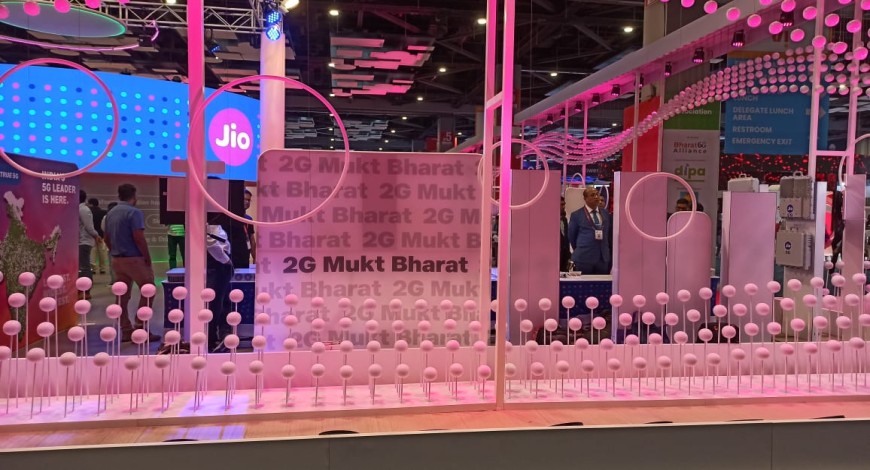

In October 2023, Reliance Jio’s booth at India Mobile Congress (IMC) was decked up with three specific words, ‘2G Mukt Bharat’. In a major step towards accelerating the nationwide shift from 2G to 4G networks, it has introduced the JioBharat Phone for those who are still stuck with 2G and 3G devices. The move by the company gained momentum, however, an overall shift from 2G networks to 4G or 5G is a far-fetched dream.
While private companies in India are on a mission to upgrade networks, for several people who reside in remote and rural parts of the country, things are not as smooth as they seem. For starters, the primary challenges hindering the widespread adoption of 4G and 5G in rural India are tough geographical conditions, limited telecommunications infrastructure, high cost of spectrum and licenses set by the government and substantial capital investments for new infra. Lt Gen SP Kochhar, Director General (DG), Cellular Operators Association of India (COAI) told BW Businessworld that one significant challenge in advancing India’s telecommunications infrastructure is the high cost of spectrum and licenses set by the government.
Additionally, establishing 4G and 5G networks requires substantial capital investments for new infrastructure. “With the introduction of these advanced networks, the industry’s capital expenditures have increased, yet the return on these investments remains relatively low. To enhance network infrastructure across the country, it’s crucial for Large Traffic Generators- to contribute an equitable fair share to telecom service providers (TSPs) for the upgradation, upkeep and maintenance of the telecom infrastructure,” he said.
This revenue sharing is expected to enable TSPs to expand and improve the infrastructure, especially in rural areas, thereby enhancing service quality. Experts said that for wider adoption of these newer networks throughout India, the mobile device ecosystem needs to become more affordable, particularly in rural regions where cost barriers are more pronounced. India’s Remote Belt Amid the digital revolution in India especially after the Covid-19 pandemic, several people such as residents of Kotga village in Himachal Pradesh’s Sirmaur are still struggling to get proper network connectivity and access to the internet.
About seven to eight hours away from the state capital Shimla, the remote village is situated at a height of about 1,800 meters from sea level. This place is still struggling to get even basic network connectivity which poses a major challenge for the locals, as told by villagers. Also, students told BW Businessworld, the pandemic times were extremely difficult as they were not able to take online classes.
They used to travel two to three kilometre (KM) out of the village in search of a mobile network. Things get even harder when medical emergencies hit the region. Even after several complaints to the local administration, the issue persists.
The proliferation of high-speed networks facilitating quick data transfer has been a central challenge in the quest to create a digital India, a push given by PM Modi. While the majority of the country is now covered with optical fibre cables (OFCs) and mobile towers, some regions are yet to be covered. These areas consist of the North Eastern states, some parts of hilly states such as Himachal Pradesh, Uttarakhand, Andaman and Nicobar and Lakshadweep Islands, insurgency and extremism-affected areas and uncovered villages in border areas.
Without the basic infrastructure of mobile towers and OFCs, experts noted that there cannot be widespread adoption of 4G/5G here. Mobile towers further need a continuous supply of power to function. They need to be connected to the grid and powered through DG sets for emergency power.
In areas without access to the power grid, service providers must install renewable power to enable these towers to function. The lack of stability in the electricity supply often results in service breakdowns in these areas. Notably, the lack of deployment of such infrastructure in remote areas is also tied to the absence of economic viability for telecom service providers.
The difficulties associated with recovering costs have discouraged private players from expanding coverage to remote regions. In addition, topography and geographical limitations also affect the development of the required infrastructure. Rishi Agrawal, CEO and Co-founder, TeamLease RegTech said, “In areas where such networks are available, digital illiteracy has become a barrier to the promotion of digital inclusivity.
Lack of operational knowledge of smartphones, the internet, and other digital technologies discourages a significant chunk of the population from accessing high-speed internet. As such, they fail to take advantage of digital governance and risk getting left behind in the era of the digital economy. ” India is banking heavily on the Digital India initiative to transform the country’s socio-economic structure.
However, there exists a digital divide wherein the population in rural and remote areas is unable to access digital technologies. As such, digital literacy becomes an essential condition for the success of Digital India. In 2014, two schemes, “National Digital Literacy Mission (NDLM)” and “Digital Saksharta Abhiyan (DISHA)”, were started by the Ministry of Electronics and Information Technology (MeitY).
Over 53 lakh beneficiaries were trained and certified under these schemes. Post-2016, the Pradhan Mantri Gramin Digital Saksharta Abhiyan (PMGdisha) was introduced to impart digital literacy to over six crore people in rural areas. This scheme provided for one member of every rural household to be trained and certified, allowing them to operate computers and digital devices and use information technology-related services.
Over 4. 3 lakh training centres have been set up, wherein more than 6. 2 crore individuals have completed their training.
Among these, 4. 6 crore students have been certified by national-level certification agencies such as NIELIT, NIOS, IGNOU, etc. Agrawal mentioned, “The union government has been playing a pivotal role in transitioning the country from 2G connectivity to high-speed network connectivity via 4G and 5G.
Fast and reliable broadband connectivity has been deemed an essential requirement for achieving the UN Sustainable Development Goals. The government has recognised the need for India’s digital transformation and deployed the Digital India programme. Data and connectivity are among the key pillars that support this transformation.
” Economic Benefits As per the data, the Indian telecom sector plays host to 1. 17 billion mobile users, garnering a teledensity of 84. 62 per cent, 7.
70 lakh mobile towers and 27. 60 lakh BTS; with OFC rollout crossed 37 lakh KM as of March 2023 which enables connectivity to 832. 2 million broadband users along with mobile subscribers.
The evolution of mobile networks from 1G to 5G has seen significant improvements in data speed, call quality and the ability to support a wide range of data-intensive applications and services, transforming how we communicate and use mobile devices. Indian telecom operators have invested over Rs 1. 5 lakh crore in infrastructure in the last year.
The total investment required to make India’s telecom infrastructure 5G-ready is estimated to be between Rs 1. 5 lakh crore and Rs 2. 5 lakh crore, according to Crisil Research.
This investment will be needed to deploy more 5G towers, upgrade existing towers, and expand fibre networks. India is also setting up 100 labs across the country for developing 5G-driven applications and subscriptions are likely to hit 350 million by 2026. It has covered about 750 districts with 5G within one year.
Telcos have deployed more than 3. 5 lakh BTSs since the start of 5G services i. e.
1 October 2022 till 30th September 2023. The transition beyond 2G is expected to accelerate the growth of India’s digital economy by fostering increased internet connectivity, ecommerce, digital payments and online services. The deployment and maintenance of advanced mobile networks, along with the development of new technologies and services are likely to create job opportunities in the telecom sector, contributing to overall economic development.
“Higher-speed networks enable businesses to improve productivity through efficient communication, cloud-based applications, and the adoption of advanced technologies. Improved connectivity enhances telemedicine services, remote patient monitoring, and the development of healthcare applications, leading to better healthcare accessibility. Advanced mobile technologies support the growth of e-learning platforms, providing accessible and high-quality educational resources to a wider audience,” said TR Dua, Director-General, Digital Infrastructure Providers Association (DIPA).
Kochhar added that 2G, 3G, 4G and 5G technologies will run concurrently, depending on the needs of the users. Advanced mobile networks will enable widespread deployment of IoT and new generation experience for the user while helping usher in Industry 4. 0 for enterprises.
“Further, with 5G, the industry can avail benefits from technologies like network slicing, edge deployments, customised private networks, etc. leading to a surge of new applications and services,” he stated. The Collaboration To provide ubiquitous connectivity, India has made several efforts to reduce the coverage gap through multiple policy initiatives such as the National Digital Communications Policy 2018 (NDCP 2018) and the National Broadband Mission 2019 (NBM 2019).
NDCP 2018 and NBM 2019 envisage promoting ‘Broadband for All’ by creating robust digital communications infrastructure in the country for socio-economic development while ensuring service quality and environmental sustainability. Dua added that to ensure universal connectivity, it is important to adopt a comprehensive and integrated approach with a focus on both rural and urban areas, infrastructure and services along with the public and private sectors. The government needs to invest more in infrastructure, such as fibre optic cables and towers.
This is especially important for rural and remote areas. Notably, about 38 per cent of telecom towers are fiberised catering to 7. 7 lakh towers, however, 65 per cent of telecom towers need liberalisation to make India 5G-ready.
Kochhar asserted, “The significant investments required in infrastructure development is a major challenge, especially in rural and remote areas, as it presents the risk of widening the digital divide since the urban areas might benefit more rapidly from these investments compared to the rural ones. ” According to the experts, India can benefit from establishing partnerships with trusted global and domestic technology providers for building and managing its mobile networks. Countries like the United States, South Korea and Japan have adopted regulatory measures to manage the risks associated with advanced mobile technologies.
India can develop clear policies and regulatory guidelines for operators and technology providers to suit the unique requirements of our country while focusing on security compliance. .
From: businessworld
URL: https://www.businessworld.in/article/Limited-Infra-Complex-Geography-India-s-2G-Free-Mission-Is-Not-An-Easy-Task/06-12-2023-501014