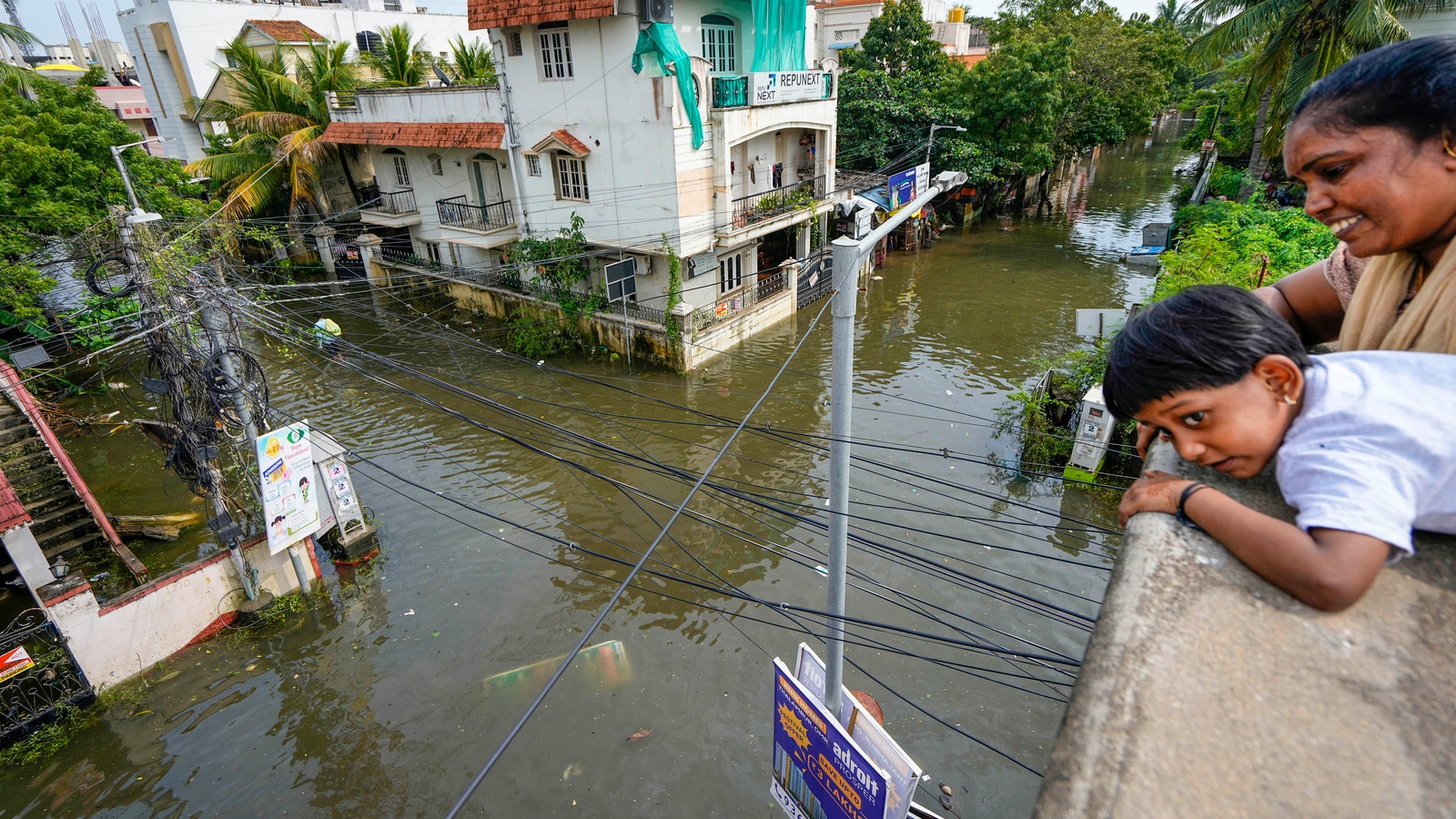

“Chennai has been in depression since December 4,” a 40-something Chennaiite, who heads an equity market research firm said when asked about how the city was coping nearly a month after torrential rains devastated it and four adjoining districts. The resident’s description is also a comment on how much the city lost to the ravaging waters in the span of a week, from communication and power lines to food availability, mobility, and infrastructure. PREMIUM An inundated area amid floods after heavy rainfall in the aftermath of Cyclone Michaung, in Chennai.
(PTI) Cyclone Michaung struck Chennai on December 4, 2023, while making its way northwards from Tamil Nadu, eventually making its landfall between Nellore and Machilipatnam in Andhra Pradesh on December 5 2023. At least 20 people were killed and thousands were marooned in the city. According to the state government, over 40 cm of rainfall inundated the city in a period of 48 hours in early December, submerging residential buildings, and washing away cars and cattle mercilessly with its strong currents.
In 2015, the city faced similar devastation when the city received 50 cm of rainfall in a single day, the highest ever in a century, making it an abnormal meteorological event. By comparison, Chennai received 8. 4 cm in 2022 November, which was the highest single-day rainfall received that year.
But the story of Chennai’s death, devastation, and destruction is as much about weather patterns as it is about the unplanned construction and non-adherence to building codes. If 2015 was a man-made disaster that came calling because of unregulated construction over floodplains, lakes and ephemeral streams, the 2023 disaster was a combination of bad weather and worn infrastructure. 2015 served the residents a notice of what could worsen in the coming years.
Still, city planners said that successive governments since then have been tardy in their response to build institutional capacity and take a holistic view of the situation. “Chennai city is just six metres above sea level and it is prone to flooding more than any other coastal city in India. It is largely because Chennai’s monsoon is the northeastern monsoon, which is a retreating monsoon, unlike the southwestern monsoon.
The NE monsoon is unstable and has a high degree of variability,” said Raj Bhagat Palanichamy who is an independent climate action researcher and environmental conservationist. Mumbai, the western coastal city that bears the brunt of an atypical monsoon each year is at an elevation of 15m, while Kochi and Visakhapatnam, are at 26m and 45m above sea level. But Palanichamy and other experts said that the Bay’s behaviour also accounts for Chennai’s vulnerability.
The Bay of Bengal Sea is known to be more aggressive than its western counterpart, the Arabian Sea. This causes the low-pressure systems to quickly mature into depressions and cyclones bearing clouds that could quickly flatten a city drenching it with more than 50 cm of rainfall in a single day. Given that the city has the second longest coastline in the country at 1,075 km, the sea’s waters, made warmer by the hot climes offer ample opportunity for the many a cyclone to gather force within a short period.
‘What, Where, and How We Built’ As a city that was built over 600 lakes, “it all boils down to what, where, and how we built what we built,” Raj Palanichamy said. The Adyar, Cooum, and Kosasthalaiyar rivers — explain where they are in relation to the city to allow rainwater to drain naturally, he added. As part of green infrastructure, rivers need stormwater runoffs as buffers to help hold all the excess water before it finds its way into the sea.
In addition, a densely vegetated riparian buffer, like a wetland on both sides of the river also helps in holding all the excess silt that spills over when rivers flood. Even until the late 19th century, Chennai, then Madras, was counted among the world’s largest wettest cities. Chennai had more than 150 water bodies that were part of a flood mitigating system in the urban areas and the suburbs.
Researchers at Chennai’s Anna University state in their 2021 paper that between 1893 and 2017, the area of Chennai’s water bodies shrank from 12. 6 square km to about 3. 2 square km, paving the way for rapid urbanisation, industrialisation, particularly the IT corridor that came up in 2008 on 230 sqkm of marshland.
Subsequently, when the Chennai Rivers Restoration Trust (CRRT) was formed in 2006 to restore lakes and rivers, the Chennai Corporation first realised the city’s rivers and waterways (Buckingham Canal) were almost ‘biologically dead’. In the years to follow, however, despite good intentions and reasonable attempts to clean up rivers to protect the marine ecosystem, the government’s efforts proved abortive because of a lack of a ‘whole river basin’ approach to addressing the issue of flooding, experts reckon. “Improper planning at the design phase is the main culprit.
When building residential or commercial complexes, rainwater needs to be accounted for every square meter or square foot. So, one of the first things that need to be implemented in urban spaces is the installation of rainwater systems in existing and new buildings after understanding the storage capability of the building. We need to build larger storage tanks to plan for proper planning for flooding.
These rainwater systems capture your roof water, clean surface water, and filter it before sending it to the storage tank,” said Chungi. Spatial designers like Akila Chungi, a built environment designer, is the Co-Founder of Native Matter, a firm that assists the construction industry with environmental aspects. Firms like hers have for long urged firms and families to factor in the topography and layout of the land before any construction is undertaken.
Structures could be legal and yet not conform to building norms, they say. Work has been on since 2006 to scientifically understand the ecology and topography to protect sensitive areas and create buffer zones around them before granting permission for construction. The Chennai Metropolitan Development Authority (CMDA), the nodal planning body that the government relies on in known to have incorporated many changes after the 2015 flood.
Its Revised Master Plan that it produced after the 2015 flood is supposed to have identified areas of improvement concerning planning, construction, and implementation. One of the experts HT Premium spoke to is on the panel of this CMDA Planning Commission that has now brought on board hydrologists, geologists, agricultural experts, besides green building advisors. The expert declined a request to be identified because he is a government servant.
The CMDA, in its Revised Master Plan 3 (RMP 3) has two parts to the protection and restoration of water bodies. One, a ₹ 100 crore comprehensive lake development project to restore 10 lakes in the city over a period of five years. Second, eight other water bodies would be restored in southern and northern regions of Chennai covering an expanse of 484 acres at a cost of ₹ 73 crore.
This second project would be funded by the Union government under the aegis of the National Disaster Mitigation Fund (NDMF). This restoration would deepen the lakes and help increase the water holding capacity by up to 1 million cubic metres depending on the size of the lake. Build for Resilience “The CMDA has held several meetings with all stakeholders to take their inputs after it was heavily revamped.
In the last 1. 5 years, much has changed,” the panel member said. As part of its policy analysis paper, the Middle East Institute (MEI), one of the not-for-profits that is advising the TN government on climate affairs noted in its paper that besides planning, another crucial spoke in the wheel would be the development of city disaster risk resilience strategy.
Disaster-resistant shelters, public buildings, and critical infrastructure, such as water and sewerage networks, need to be improved to avoid water logging and enhance community resilience, it said in its 2021 authored note. Jaya Dhindaw, an urban development professional with over two decades of experience in sustainable development at The World Resources Institute, said, however, that the masterplans have to be not just revised, but implemented. “Among others, the reasons for this kind of flooding are inadequate and old (over 100 years in some cases) drainage infrastructure- cities have expanded without proper extension of this infrastructure; the drainage master plans are old and have not been updated to keep up with the city’s growth and developmental change,” she said.
While some of the above measures could be undertaken within a decade, the creation of coastal embankments and strict enforcement of Coastal Regulation Zone (CRZ) codes necessary to protect against sea-level rise would take up to twenty years experts of all hues agree. Following the CMDA’s recommendations, the government undertook a lot of canal works but the devastation caused by the recent flood would mean augmenting the existing canals with engineering work to facilitate watershed management and the adoption of the ‘sponge city’ concept could mitigate flood risks. To ensure speedy implementation, the state is looking at involving the local bodies and sharing the responsibility of overseeing the reconstruction of the stormwater drains.
“If there’s a China-like push where massive projects are executed at a break-neck speed, then at least the deficiencies in four districts that were affected can be addressed in five years,” said Raj Palanichamy. One of the major concerns in the four districts of Tuticorin, Tirunelveli, Tenkasi, and Kanyakumari that were flooded, include the lack of involvement of the local municipal bodies and budget constraints. With the districts being deficient in industrialisation, their sources of tax collection are limited.
They are totally dependent on doles from the state government from its budget for undertaking works requiring large capital outlay. However, the cost is one of the major concerns that would prove to be a spanner in the works. Repair and restoration work in Chennai including street redesigning alone is expected to cost ₹ 25,000 crore over 10 years.
The revenue receipts of the Chennai Corporation for the year 2023-2024 so far stand at ₹ 4,131 crore, throwing light on the financial health of implementation agencies. WRI’s Jaya Dhindhaw makes an important point suggesting that climate-resilient infrastructure should also be covered under Public-Private-Partnership projects to improve public procurement processes and foster innovative solutions. She advocates the need for a separate budget rather than tapping into the corpus of the National Disaster Management Authority.
Political will alone is not enough; Political stability required For long-term sustainable projects, the advisors to the government have recommended the introduction of corporation bonds and the allocation of municipal budgets. “For all this to take off, there must be political stability in states. Political will alone is not enough and corporations should not be looked upon as avenues of enrichment,” said the TN climate change panel member.
With climate change bringing down the time between disasters, it is incumbent on governments to stay prepared for all forms of climate risks. Excessive rainfall years could herald drought years, those that have been watching the climate change say. To predict how a year is going to turn out, G Sundarrajan, chief advisor to TN on climate action said that the governments should rely on technology to stay updated on specific measures of prevention and preparation.
“The government is proactively taking measures to adopt better hydro-meteorological models for tropical countries which would render more accurate predictions. Highlighting the range of variance between Indian and European weather prediction systems, he said, “The IMD forecasted a rainfall of 12-20 cm in Tuticorin; whereas the district received 95 cm of rainfall in under 16 hours!” Since December 16, the final day of the torrential rainfall, while critics and experts have picked up a cudgel for many an affected group – fisherfolk, farmers, and villagers, castigating the government for having done precious little since 2015, Sundarrajan said. “Never compare two disasters.
But always learn what both have to say. Be prepared for the worst,” he added. Unlock a world of Benefits with HT! From insightful newsletters to real-time news alerts and a personalized news feed – it’s all here, just a click away!- Login Now! Get Latest India News and Aditya L1 Live Updates along with Latest News and Top Headlines from India and around the world Continue reading with HT Premium Subscription Daily E Paper I Premium Articles I Brunch E Magazine I Daily Infographics Subscribe Now @1199/year Already Subscribed? Sign In SHARE THIS ARTICLE ON Share this article Share Via Copy Link Chennai Depression.
From: hindustantimes
URL: https://www.hindustantimes.com/india-news/chennais-road-to-recovery-after-devastating-december-floods-101704563303345.html