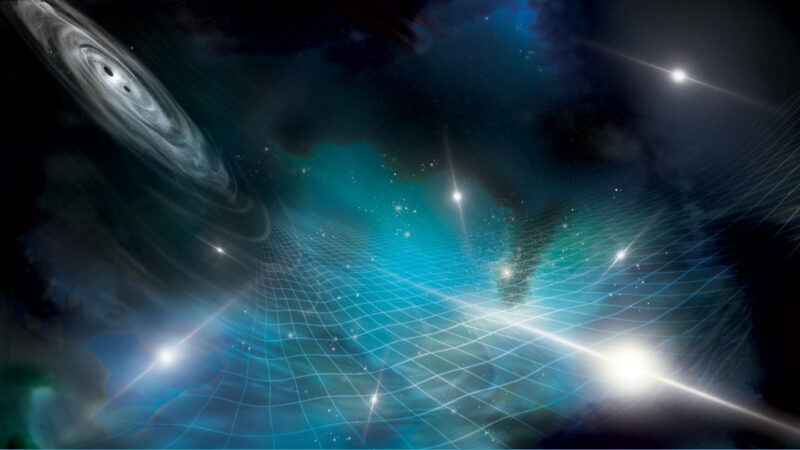

By Beneath the explosions, collisions and other intermittent bangs in the cosmos, scientists suspect a nonstop soundtrack plays, created by ripples in spacetime continually washing through the universe. After more than a decade of searching, scientists may have finally heard that background hum. Several teams of researchers from around the world reported on June 28 the first clear evidence of these gravitational waves.
Unlike previously detected gravitational waves, these new ones have ripples that are staggeringly long — on the scale of light-years. Their likely source: innumerable pairs of gargantuan black holes, which churn the spacetime cauldron as they orbit one another. If that hunch is correct, the result would provide the first evidence that pairs of monster black holes, with masses billions of times that of the sun, can coalesce into one.
If the gravitational waves are real, and if they truly are a signal of supermassive black hole pairs, “it’s miraculous,” says astrophysicist Meg Urry of Yale University. “It’s extremely interesting, because we have essentially no handle on what the most massive black holes are doing. ” Gravitational waves are produced by accelerating, massive objects.
As these waves careen through the universe, they rumple the fabric of spacetime upon which reality is embroidered. In 2015, scientists with the Advanced Laser Interferometer Gravitational-Wave Observatory, or LIGO, ( ). Those waves were spawned by mergers of , entirely different beasts than the supermassive ones that lurk at the centers of galaxies ( ).
While LIGO picks up gravitational wave blips that can last mere fractions of a second, orbiting supermassive black holes are expected to pump out waves continually for millions of years, creating ripples that blanket the cosmos with their constant hum. “This is a very different sort of thing, very new sort of thing,” says LIGO researcher Daniel Holz, an astrophysicist at the University of Chicago. “That is awesome.
” Across the universe, galaxies regularly mingle and merge. As they do, scientists suspected, their supermassive black holes would orbit one another and emit gravitational waves. Many pairs of black holes would be doing this orbital dance at once, in the many merging galaxies scattered throughout the cosmos, all sending their spacetime ripples out into space.
“The Earth is just randomly bumping around on this sea of gravitational waves,” says astrophysicist Maura McLaughlin of West Virginia University in Morgantown and a member of the North American Nanohertz Observatory for Gravitational Waves, or NANOGrav. Detecting this mishmash of gravitational waves is not easy. The task required scientists to MacGyver the Milky Way, turning the galaxy into a gravitational wave detector by timing the clocklike ticking of dead, spinning remnants of exploded stars called pulsars, which emit beams of radio waves as they twirl.
These beams sweep past Earth at regular intervals, like the precise ticks of a clock. Gravitational waves stretching and squeezing the space between the pulsars and Earth cause the pulsars’ ticks, observed with a variety of radio telescopes around the world, to come early or late. To ensure that they were seeing the gravitational waves, rather than uninteresting jitters, the researchers looked for a special type of correlation between different pulsars.
Pulsars near one another on the sky should show similar timing shifts, but those that are at right angles to one another should observe opposite shifts: One pulsar’s blips come early while the other’s come late. That compelling hallmark has finally been observed, NANOGrav researchers reported June 28 in the . “There’s nothing in nature that can mimic this,” says Chiara Mingarelli, an astrophysicist at Yale University and NANOGrav researcher.
“Only gravitational waves can make that. ” Their result was based on 15 years spent monitoring dozens of pulsars. Get great science journalism, from the most trusted source, delivered to your doorstep.
“It’s really invigorating stuff,” says astrophysicist Michael Keith of the University of Manchester in England, a member of the European Pulsar Timing Array, or EPTA. The EPTA team spent an even longer time staring at pulsars — a quarter of a century. “We were getting to the point where we were starting to think maybe the signal is just so weak, we’ll never ever find it,” Keith says.
But the telltale correlation between pulsars was also evident in the EPTA results, which were reported June 28 in with researchers from the Indian Pulsar Timing Array. Some scientists have thought that supermassive black holes in merging galaxies would never draw close enough to coalesce with one another, or to emit gravitational waves like the ones observed. “It’s actually been a sore spot for our field for many years,” Mingarelli says.
In contrast, the gravitational wave signal ( : 6/3/23). That suggests, “there are many black holes, they merge happily, and black holes also grow [to large masses] very happily,” says astrophysicist Marta Volonteri of Institut d’Astrophysique de Paris, who was not involved with the new research. Future work could reveal more about supermassive black holes and their environs, says astronomer Ryan Shannon of Swinburne University of Technology in Melbourne, Australia.
“Understanding better the demographics of these supermassive black holes is going to help us understand how galaxies form and evolve,” says Shannon, a researcher on the Parkes Pulsar Timing Array in Australia, which also reported independent results in the and . A shorter-term effort, from the Chinese Pulsar Timing Array, reported its results in . The teams stopped just short of declaring an ironclad detection of the background of gravitational waves, rather presenting their results as strong evidence for the ripples.
Taken individually, their results don’t quite meet the most stringent standards for statistical significance set by physicists. In future work, the teams plan to combine their data, in hopes of further solidifying the detection. And although supermassive black holes are the simplest explanation for the waves’ origins, researchers still can’t rule out a more exotic provenance.
For example, the ripples might have arisen from inflation, the period just after the Big Bang when the universe is thought to have ( ). Whatever the source, the future study of these gravitational waves is bound to have ripple effects. G.
Agazie . . Published online June 28, 2023.
doi: 10. 3847/2041-8213/acda88. G.
Agazie . . Published online June 28, 2023.
doi: 10. 3847/2041-8213/acdac6. G.
Agazie . . Published online June 28, 2023.
doi: 10. 3847/2041-8213/acda9a. A.
Afzal . . Published online June 28, 2023.
doi: 10. 3847/2041-8213/acdc91 G. Agazie .
The NANOGrav 15-year data set: An astrophysical interpretation of a gravitational wave background from supermassive black hole binaries. In press, 2023. J.
Antoniadis . The second data release from the European Pulsar Timing Array I. The dataset and timing analysis.
. Published online June 28, 2023. J.
Antoniadis . The second data release from the European Pulsar Timing Array II. Customised pulsar noise models for spatially correlated gravitational waves.
. Published online June 28, 2023. J.
Antoniadis . The second data release from the European Pulsar Timing Array. III.
Search for gravitational wave signals. . Published online June 28, 2023.
A. Zic . The Parkes Pulsar Timing Array Third Data Release.
. Published online June 28, 2023. D.
J. Reardon . Search for an isotropic gravitational-wave background with the Parkes Pulsar Timing Array.
. Published online June 28, 2023. D.
J. Reardon . The gravitational-wave background null hypothesis: Characterizing noise in millisecond pulsar observations with the Parkes Pulsar Timing Array.
. Published online June 28, 2023. H.
Xu . . .
Vol. 23, July 2023, p. 075024.
doi: 10. 1088/1674-4527/acdfa5. Physics writer Emily Conover has a Ph.
D. in physics from the University of Chicago. She is a two-time winner of the D.
C. Science Writers’ Association Newsbrief award. Our mission is to provide accurate, engaging news of science to the public.
That mission has never been more important than it is today. As a nonprofit news organization, we cannot do it without you. Your support enables us to keep our content free and accessible to the next generation of scientists and engineers.
Invest in quality science journalism by donating today. .
From: sciencenews
URL: https://www.sciencenews.org/article/newfound-gravitational-wave-black-hole