
In 2012, researchers announced they had found what they believed was the , representing a triumph of science. Yet, researchers made the find not by looking through a telescope or analyzing data collected from a spacecraft. They found Higgs through decades of painstaking research at colliders around the world, notably CERN in Geneva, Switzerland.
CERN stands for the (or the European Center for Nuclear Research). Their research was painstaking because the life of the Higgs boson is infinitesimally short. It breaks into smaller particles in less time than it takes to blink.
Scientists at CERN spent $10 billion over the decades chasing the elusive particle [source: ]. Advertisement The discovery put CERN on the front page. Yet, most people still have no idea what the scientists at CERN actually do.
We can help with that. CERN, which mainly focuses on particle physics, has existed since the 1950s. At the end of , Europe was a mess and its scientific community a shambles.
Scientists in the United States, which included many plucked from Europe, had taken the lead in physics. In 1949, French quantum physicist Louis de Broglie proposed that Europe try to recapture its scientific glory by creating a multinational atomic physics laboratory. Advertisement CERN Members and Observers A few years later, CERN was born and built just outside Geneva.
The 12 founding states included Belgium, Denmark, France, West Germany, Greece, Italy, the Netherlands, Norway, Sweden, Switzerland, the United Kingdom and Yugoslavia. As of January 2023, 23 countries, including Israel, Poland and Finland, are CERN members, and each one gets two spots on the CERN council (the decision-making body) but a single vote on such decisions. CERN’s Director-General, Fabiola Gianotti, essentially functions as the leader.
The United States is not a member but an observer state — that is, one that can attend meetings and get info but not vote on CERN matters [source: ]. (Speaking of the U. S.
, it contributed $531 million for the construction of several LHC components. ) CERN’s Goals CERN’s job was to find out how the universe worked. No big deal, right? Scientists decided the best way to accomplish this monumental task was to build giant machines that .
The hope was that these so-called atom smashers would give researchers a glimpse back to the time just after the universe came into being. Accordingly, CERN started building its very first accelerator, the Synchrocyclotron, in 1957. The Synchrocyclotron crashed and smashed its way toward 33 years of service.
CERN now operates several accelerators and one decelerator in a building complex that straddles the Swiss and French border. The cost of the experiments is spread over the member states [sources: , ]. Working at CERN By 2014, 2,400 full-time employees and 1,500 part-timers, were working at CERN, while more than 600 institutes and universities had access to its facilities to start unraveling a variety of mysteries, such as , , subatomic particles and the events that occurred a split second after the .
Moreover, 10,000 scientists from 113 countries — half of all the particle physicists on the planet — stop by CERN for research each year. And it’s not just scientists either. People work at a variety of jobs including engineers, experimental physicists and even accountants.
Scientists from member states get the first crack at a position, although CERN always considers senior scientists from other countries [sources: , ]. Connecting the World In 1989, Tim Berners-Lee, a British scientist, helped to invent the World Wide Web by developing hypertext transfer protocol, or http. Berners-Lee was keen to create a network of interactive computers so scientists all over the world could share data [source: ].
Advertisement At the heart of the European laboratory is the world’s largest and most powerful particle accelerator, an atom smasher called the (LHC). CERN’s Large Hadron Collider is made of a 17-mile (27-kilometer) ring of superconducting magnets and a series of accelerators that shoot high-energy particles through the apparatus like a bullet through a gun. Located 328 feet (100 meters) below ground, the collider blasts particle beams in one direction, while another beam travels in the opposite direction.
Advertisement Use any exclamation you want. At top speed, the particles smash into each one at 99. 9999991 percent the speed of light [source: ].
Every time the protons smash into one another, it creates a complex spray of other particles. Many of those particles last for less than a second but leave a trail of subatomic breadcrumbs that scientists can follow. To follow that trail, scientists rely on two highly complex particle detectors, which allow them to see the elementary building blocks of our universe.
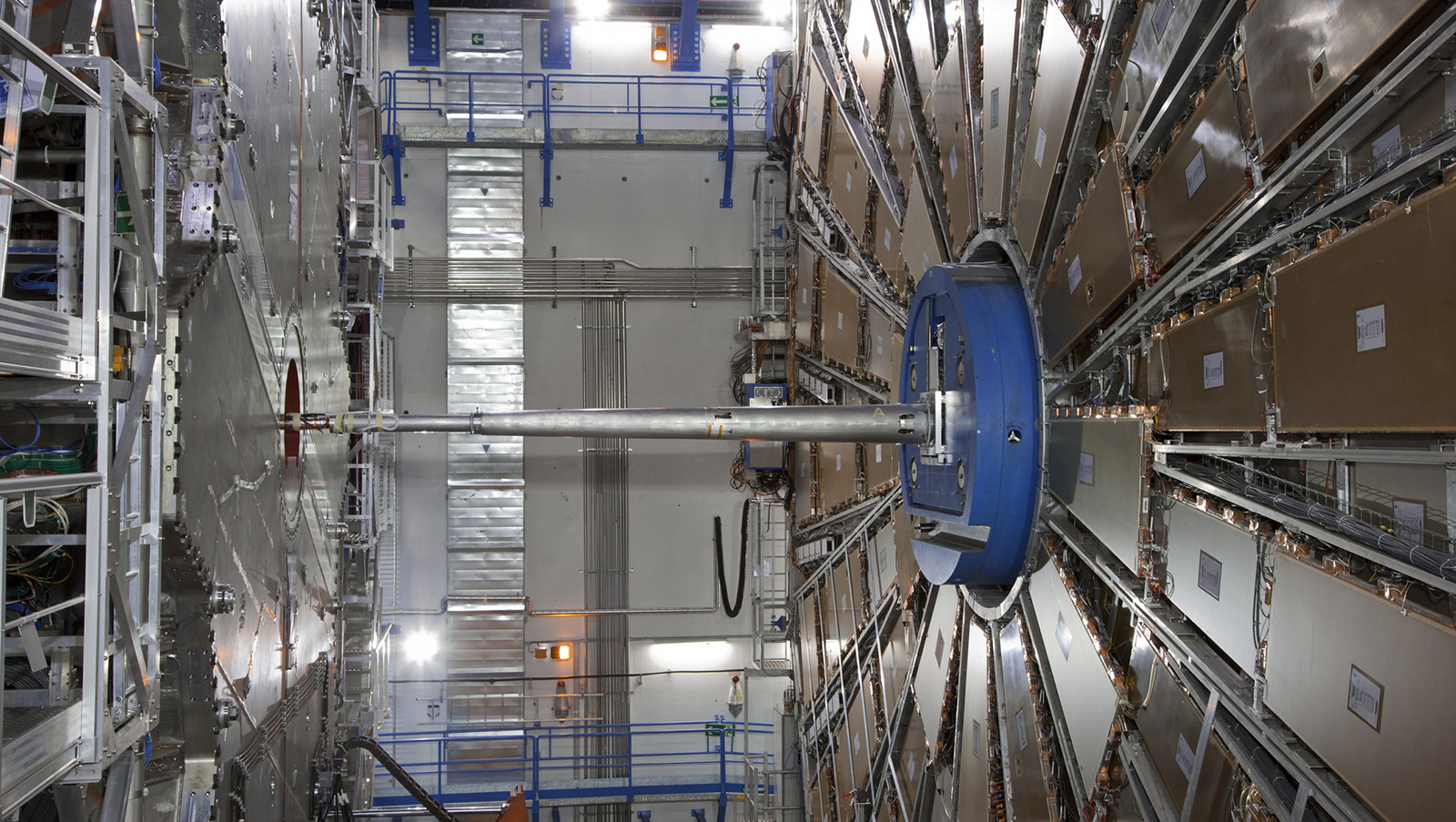
One of those detectors is ATLAS. The machine, which is about 148 feet (45 meters) long and 82 feet (25 meters) high, helped find the Higgs boson particle. ATLAS is half as large as Notre Dame (the cathedral, not the university) and weighs as much as the Eiffel Tower (the one in Paris, not Las Vegas).
CERN scientists use ATLAS and the other detectors (ALICE, CMS, LHCb, LHCf) to study stuff you read about only in sci-fi books, such as whether other dimensions exist, what type of unifying force might be in the universe and if there’s evidence of . Only two detectors, ATLAS and CMS, were devoted to solving the Higgs boson mystery. All CERN experiments at the LHC are distinct and run by a worldwide collaborating team of scientists [sources: ATLAS, ].
Advertisement Smashing particles together at nearly the speed of light is one thing; interpreting the data from those collisions is another. Particle collisions in the LHC happen at nearly 600 million times a second [source: Sakai]. The information spewing out of those crashes can tell us volumes about the inner workings of the atom and the forces that hold the atom together, but we certainly can’t record all of the information from the detectors.
Advertisement Overwhelming Amounts of Data ATLAS, for example, could fill 100,000 CDs with data every second. Instead, ATLAS, like the other detectors, can record only a “smidgen” of info, roughly enough to put on 27 CDs per minute [source: ATLAS]. While that number is only a portion of the available information, it’s still an overwhelming amount.
The detectors transfer what they find to the CERN Data Center, where technicians and researchers use computers to digitally reconstruct each collision. During reconstruction, scientists test their theories of how particles behave. They compare computer-simulated collisions to the actual collisions.
A disparity between the two might signify new science, something that had gone unexplained [source: Sakai]. Each day, the data center processes one petabyte of information. It would take 223,000 DVDs to hold all the information in a petabyte [source: ].
To make things more difficult, scientists pore through 30 petabytes each year, which makes new science incredibly difficult to find [sources: , ]. The Grid Given those staggering numbers, CERN’s data hub can’t crunch such numbers all by itself. Instead, scientists rely on the planet’s largest computing network, the Worldwide LHC Computing Grid, an association of 170 computer centers in 40 countries.
The grid is the “most sophisticated data-taking and analysis system ever built for science. ” It runs more than 2 million jobs a day and can transfer 10 gigabytes of data from its servers every second. Without the grid, the Higgs boson might have gone undiscovered [source: ].
Atomic Vacation If you’re ever vacationing in Geneva, you can tour CERN for free, but be sure to visit the website first and submit a request. Don’t forget your passport or identity card. Also, leave your children under 13 (for group tours) at home, along with high-heeled shoes, sandals and flip-flops.
You can’t smoke, either [source: ]. Advertisement.
From: howstuffworks
URL: https://science.howstuffworks.com/science-vs-myth/everyday-myths/cern.htm